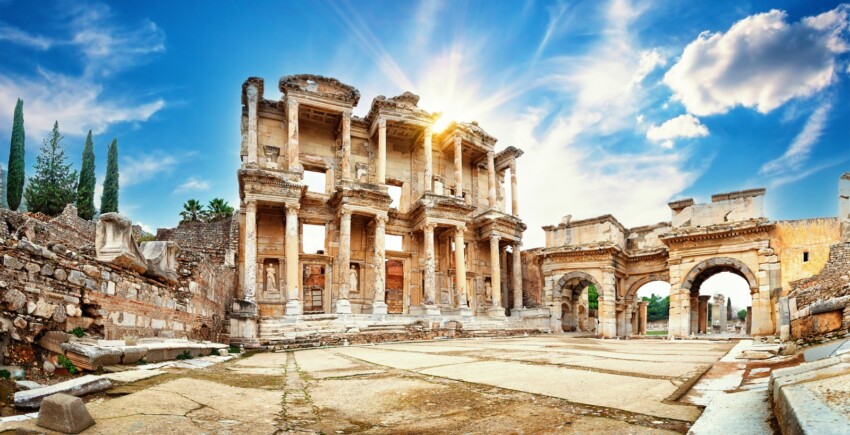
Ephesus (or Efeso) is a location that nowadays falls within the territory of the city of Selçuk, but in ancient times it was an important centre not only economically and commercially, but also politically and intellectually. Its origins are steeped in myths and legends, but what is known of Ephesus is that it was dominated first by the Greeks, then by the Macedonians under Alexander the Great, and finally by the Romans, who in 129 BC made it the capital of the Roman province of Asia. With the shift to Byzantine control, Ephesus gradually lost importance, and the city was eventually abandoned entirely during Ottoman rule.
Today, Ephesus preserves one of the most important archaeological sites of the Mediterranean Sea, which reveals how its strategic position made it a highly coveted territory and an important commercial hub. It was not until the mid-19th century, coinciding with the construction of the railway network, that the first excavations in the area began, leading to the discovery of the site and its subsequent valorisation. The historical and archaeological significance of this place led to Ephesus being designated a UNESCO World Heritage Site in 2015.
The ancient city of Ephesus is considered an open-air museum, so much so that visiting this site amounts to taking a journey back in time thousands of years. At the height of its splendour, during Roman rule, Ephesus is estimated to have had a population of around 250,000 inhabitants, and the city was characterised by truly magnificent buildings rivalling those of Rome.
All around the city, a mighty city wall had been constructed, roughly 8 km in length. Today, only the remains can be seen, with entry and exit secured by three gates: the Magnesian Gate (on the road to the House of the Virgin Mary), the Koressos Gate (at the rear of the Stadium), and the Harbour Gate.
Within the city, Ephesus was divided into two main areas: one devoted to political and religious life, while the other was reserved for leisure and entertainment. The two zones were connected by splendid avenues, the principal ones still passable today being: the Arcadian Way, the Street of the Curetes, and Marble Street.
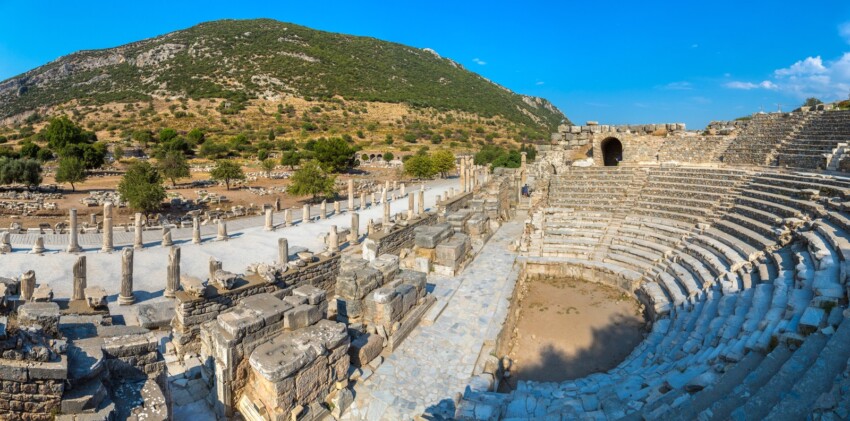
The journey through ancient Ephesus begins with a visit to the Odeon, a type of theatre built in the 2nd century AD for holding political meetings at the behest of Publius Vedius Antonius and his wife Flaviana, two wealthy citizens of the time. At its height, the complex could accommodate up to 1,500 people and the entire Odeon was covered with a wooden roof; the upper part of the cavea was decorated with Corinthian columns in red granite.
Over time, this space, owing to its capacity and configuration, was also used for theatrical performances, featuring a well-decorated two-storey stage. Near the Odeon stood the Prytaneion, where religious ceremonies were held and the sacred hearth was kept, which was guarded by the goddess Vesta, protector of the Roman Senate.
The agora of Ephesus was considered the heart of civic life and was divided into a civic agora and a commercial agora. The civic agora was a square measuring 160 x 58 metres, restructured in the Augustan period when a wealthy local benefactor funded the construction of a basilica with three naves on the north side, dedicated to the goddess Artemis. To the north of this basilica stood two small temples dedicated to Rome and Caesar, surrounded by two typical Greek buildings that housed the magistracy and city council. In the centre of the area, a temple (Sebasteion) was later built, dedicated to the cult of Augustus.
The commercial agora, by contrast, was Ephesus’s most important commercial area and was initially built in the 3rd century BC, but underwent several alterations. The ruins visible today date from the time of Caracalla (3rd century AD). The agora is entirely bordered by columns, with three of its sides surrounded by a row of porticoes that housed shops and businesses, while at the centre of the Agora stood a water clock and a sundial.
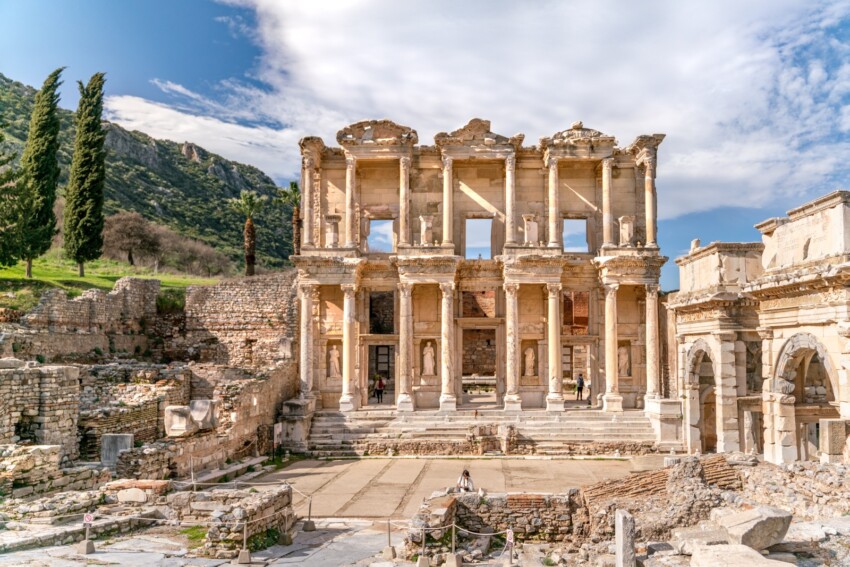
From the commercial agora, it is easy to access the Library of Celsus, which was built in the 2nd century AD in honour of Gaius Julius Celsus Polemaeus, governor of the province of Asia. At the height of its glory, the library held over 12,000 scrolls and was considered one of the largest in the world, after those of Alexandria and Pergamon. A cultured, wealthy and influential man, Gaius Julius Celsus had requested to be buried in the library, which thus became both a repository of knowledge and a mausoleum.
The Library is considered the best-preserved ancient building on the entire site, and it is still possible to admire the façade in almost its full splendour. The entrance was preceded by a staircase of nine steps leading to the façade decorated with 16 columns arranged in pairs and finely adorned with botanical motifs and mythological figures. Between the columns are niches containing four female statues: Sophia, representing wisdom; Arete, representing virtue and courage; Episteme, representing science and knowledge; and Ennoia, representing thought.
Near the great agora also stood the Temple of Domitian, of which only a few remains survive today, though it was actually one of the largest buildings of ancient Ephesus. The temple was erected by the emperor Domitian himself in honour of his father, the emperor Vespasian, founder of the Flavian dynasty that ruled the empire from 69 to 79 AD following a period of great instability. The temple is known to have been built on a high and expansive terrace and had eight columns on the short side and thirteen on the long side, whilst inside stood an altar now housed in the Izmir Museum.
Much of the building has been destroyed, and today only two magnificent columns and two caryatids supporting an architrave remain visible. The Temple of Domitian stood in the eponymous square, where the Fountain of Pollio was located, which via an advanced aqueduct system brought water to the city, and the Monument of Memnius, a memorial dedicated to Memnius, son of Gaius and grandson of Sulla.
Recent excavations conducted not far from the Library of Celsus uncovered the residential quarter with numerous “terraced houses” (or Domus terrazzate), inhabited by the wealthiest and most noble families, where fine decorations and frescoes were discovered. The houses here were mostly two storeys: on the ground floor was the daytime zone with the living room, common hall and dining room, whilst the upper floor contained the sleeping quarters with bedrooms.
Roman houses even then were equipped with an innovative heating system, consisting of clay tubes beneath the floors and behind the walls that circulated hot air throughout the dwellings. Two of the houses underwent careful restoration and are now open to visitors; stepping inside, one can admire the residences in all their splendour, with fine mosaics adorning the floors and stunning frescoes on the walls.
In Roman Ephesus, there were four bathing complexes, the largest of which was built north-west of the civic agora in the 3rd century. In addition to the usual rooms of a bathhouse, these baths featured two “marble halls” where ceremonies honouring the emperor took place. Outside the main complex stands the Portico of Verulanus, a square built in Hadrian’s time where physical exercise could be undertaken. In other outlying quarters to the north and east stood the other three bathing centres: those of Vedius, the Theatre, and the Eastern baths.
Another structure of major importance and well preserved at Ephesus is the Temple of Hadrian, which was erected around 138 AD with funds from P. Quintilius in honour of the emperor Hadrian, who had visited the city. The temple’s façade features four Corinthian columns supporting an arch at the centre of which stands a statue of the goddess of Victory.
Inside the temple were friezes depicting the founding history of Ephesus and a representation of Medusa amid acanthus leaf decorations. In front of the temple, four statues were erected portraying the emperors Diocletian, Maximian, Constantius I and Galerius, but only their bases have survived to the present day, as the busts of the emperors were never recovered.
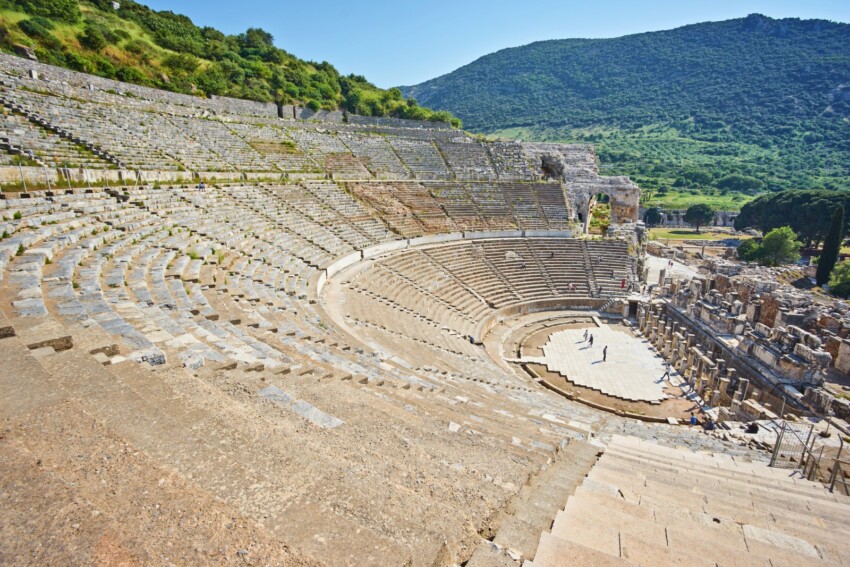
The Theatre of Ephesus, built on the back of a hill, certainly does not go unnoticed, and by its dimensions is considered the most imposing building of the city. This was originally constructed in the Hellenistic period around 250 BC, exploiting the slope of the hillside, but was subsequently enlarged and modified repeatedly during the Roman period, eventually reaching its current structure.
In particular, work carried out around 44 AD expanded the capacity to 25,000 spectators, a detail that made it one of the largest theatres in Asia Minor.
As already mentioned, Ephesus was in the past a centre of great political, commercial, cultural and intellectual importance, so much so that it was home to the second school of philosophy in the Aegean, and its port was described as the “Gateway to the East“. The city was named by the Romans as the capital of Asia and subsequently became an important site for the major religions of the region, such as Christianity and Islam. This made its territory a place rich in testimonies of its glorious past, so beyond the archaeological site there are many other interesting stops to visit.
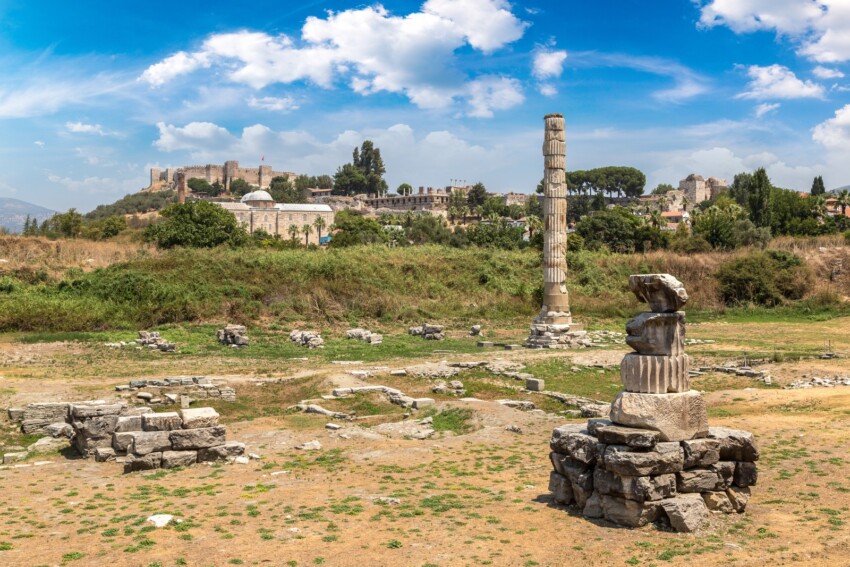
Three kilometres away from the ancient town of Ephesus, you can admire the remains of the Temple of Artemis, a building of truly magnificent proportions that was considered one of the Seven Wonders of the Ancient World. According to some research, the Temple of Artemis was considerably larger than the famous Parthenon in Athens.
Originally built by the Greeks in the 6th century BC in honour of Artemis, goddess of the hunt, it was subsequently destroyed and rebuilt several times by different emperors, including Alexander the Great. The building was finally demolished in 401 AD by John Chrysostom, Archbishop of Constantinople.
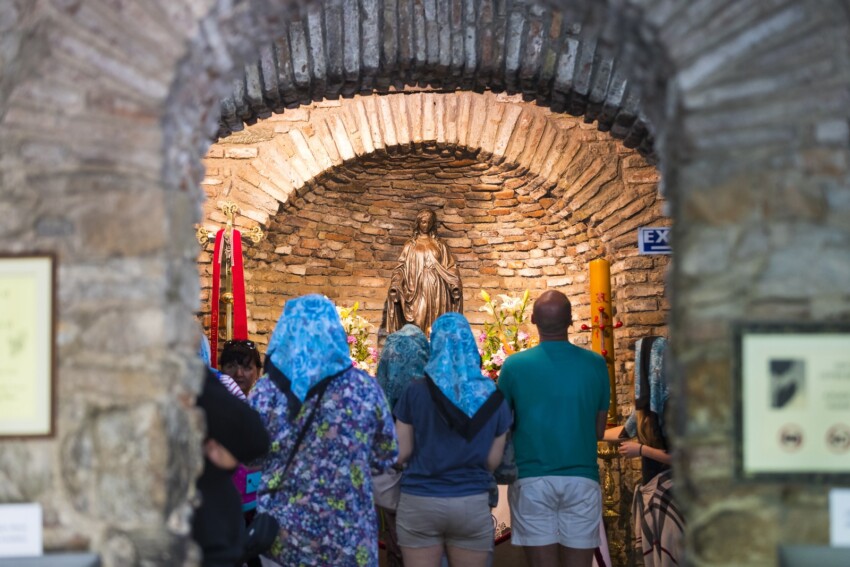
Ephesus played a very important role too in the spread of Christianity, hosting two important Councils of the Early Church, one in 431 and another in 449 AD. For this reason, not far from the Ephesus site and the centre of the modern town of Selçuk stands the House of the Virgin Mary, which is believed to have been the residence where Mary spent the last nine years of her life. Over time, this dwelling has become a place of pilgrimage for the faithful, and was eventually transformed into a small chapel where religious celebrations are still held daily. The site has been visited over the years by several popes, including Pope Paul VI, Pope John Paul II and Pope Benedict XVI.
Not far from Ephesus lies another religious site of great importance (to both Christians and Muslims), known as the “Cave of the Seven Sleepers”. According to legend, seven Christian youths who refused to make sacrifices to the Roman gods were forced to flee the city and took refuge in a cave to escape persecution. The story goes that these young men fell asleep in the cave, and when they awoke, 200 years had passed and Christianity was no longer persecuted. When the youths died, they were buried in this grotto, and a small commemorative chapel was built there, of which only traces now remain.
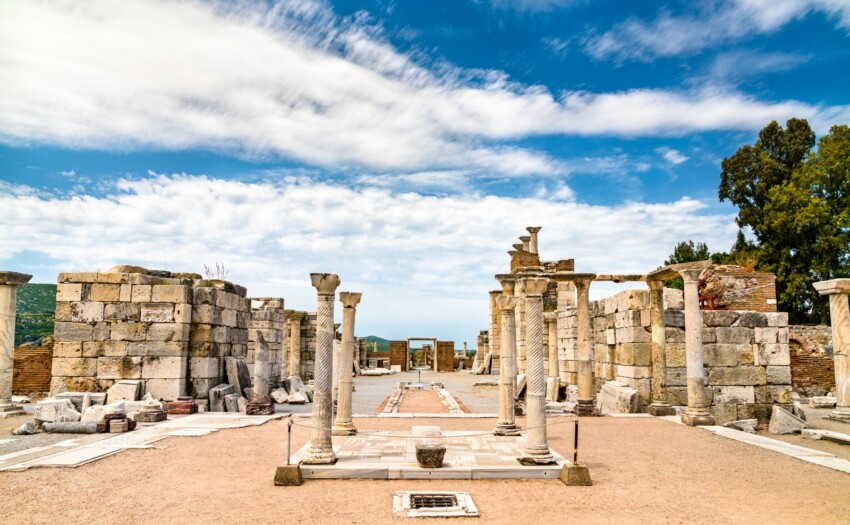
From the 6th century AD onwards, the city of Ephesus gradually depopulated as residents moved to the hill of Ayasuluk, an area that was far better protected at the time. It is in this area that the remains of the Basilica of St. John still stand, another testament to the importance this territory had assumed for Christianity. The church was built at the behest of Justinian I on the site where, centuries before, the apostle John the Evangelist was said to have been buried. It appears that John wrote many passages of his Gospel while at Ephesus. Much of the religious building has now been destroyed, and only some columns and sections of the walls of the ancient basilica survive, yet these allow us to comprehend how grand and important this church once was.
To explore the Ephesus archaeological site and other major attractions in the area, it’s recommended to base yourself in the town of Selçuk, which offers numerous accommodation options. The range of properties in town caters to different types of travellers and budgets. Other nearby alternatives include the charming village of Şirince, the coastal resort of Kusadasi, or the city of Izmir.
Ephesus is easily accessible from central Selçuk via several bus services, or given the short distance, by taxi. Selçuk itself is well connected to Izmir via railway or by bus (minivan services). Daily flights operate from Istanbul to Adnan Menderes Airport in Izmir from both of Istanbul’s airports. This airport is approximately 60 km from Ephesus, and from there you can reach Selçuk by bus, train or taxi. Izmir is also directly accessible from major international airports thanks to services operated by low-cost carriers such as Ryanair and Sunexpress.
 Hotel
Hotel  Budget accommodations
  Apartments
  Family Hotel
  Luxury Hotel