Istanbul: Bosphorus Dinner Cruise & Show with Private Table
63.791 reviews
Buy now
From 23,70€ per person
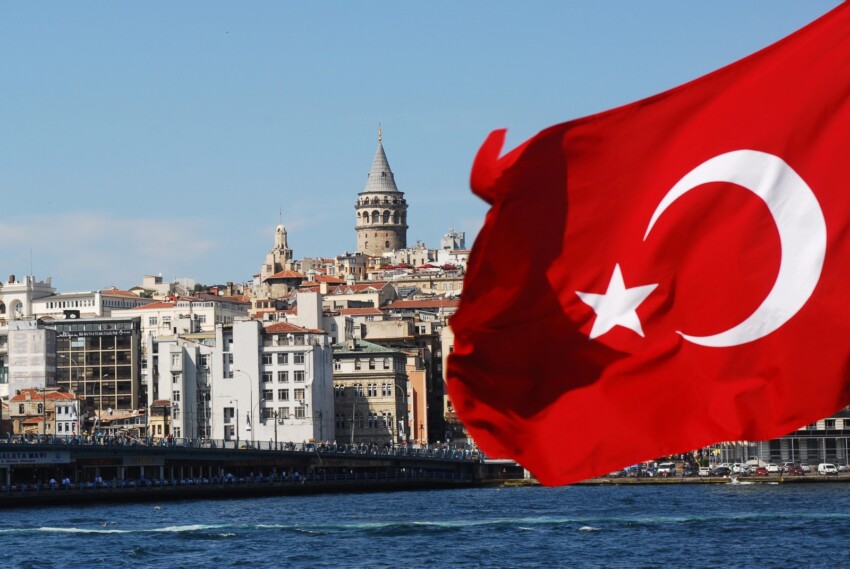
When you cross the Bosphorus or stroll through the streets of Istanbul, one visual element dominates the urban landscape: the Turkish flag. Its distinctive red field with a white crescent and five-pointed star waves everywhere, from government buildings to small shops, from mosques to private homes. The Turkish people call this flag Ay Yıldız (moon and star) or simply al bayrak (red flag), and the emotional connection of the nation to this national symbol runs deep and visceral.
But what lies behind these seemingly simple symbols? The Turkish flag tells a story spanning millennia, weaving together ancient myths, Byzantine heritage and Ottoman pride. Let’s discover together the meanings, legends and history of one of the world’s most recognisable national flags.
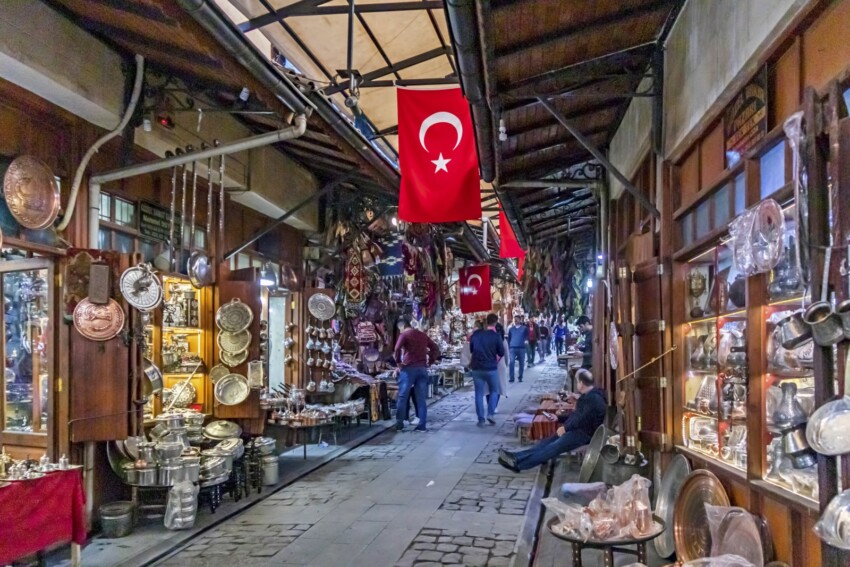
Turkey’s flag has proportions of 2:3 and is regulated with mathematical precision by Turkish law from 22 September 1983. Against a crimson red background stand two white elements: a crescent pointing to the right and a five-pointed star positioned between the points of the crescent, slightly offset towards the hoist.
The geometric arrangement is calculated with extreme precision: the distance between the centres of the star and crescent, the opening angle of the crescent, even the ratio between the inner and outer radii of the lunar crescent are established by law. This attention to detail reflects the symbolic importance the flag holds for the Turkish people.
The modern flag was officially adopted on 29 May 1936 by the Turkish Republic, but its design has roots in the Ottoman Empire. The original version of the Ottoman flag was green with a simple white crescent, reflecting the traditional colour of Islam.
It was Sultan Selim III who in 1793 decided to radically change the appearance of the standard, replacing green with red. Some historians believe this choice was linked to the traditional colours of the Turkish peoples of Central Asia, whilst others suggest it was a tribute to the Caliph Omar, a central figure in early Islam.
The five-pointed star was added only in 1844, almost half a century later, to represent the birth of a new Ottoman era. When Mustafa Kemal Atatürk founded the Turkish Republic in 1923, he retained the Ottoman design as a symbol of historical continuity, making only minor formal amendments that were codified in 1936.
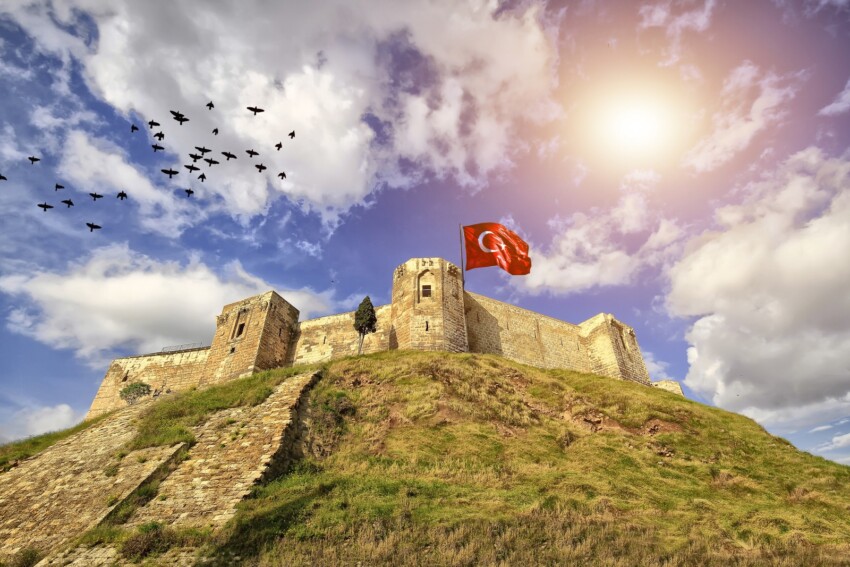
Numerous legends have developed around the Turkish flag, passed down through generations. The most popular concerns the Battle of Kosovo in 1448, a decisive clash in which the Ottomans defeated Christian forces and consolidated their dominance over eastern Europe.
According to legend, after the battle Sultan Murad II crossed the devastated battlefield at sunset. The ground was scattered with pools of blood from fallen soldiers, and in one of these pools was reflected the crescent moon and a bright star. Moved by the tragic beauty of that vision, the sultan decided to immortalise that image in the Ottoman flag.
Another legendary account concerns the first Ottoman sultan, Osman I, founder of the dynasty in the 13th century. It is said that one night he dreamed of a crescent and star emerging from his chest and expanding until they covered the entire world. Soothsayers interpreted the dream as a divine portent: Osman’s dynasty would conquer Constantinople and establish an empire that would extend across three continents.
A third legend is linked to the conquest of Constantinople in 1453 by Mehmet II. It is said that the night before the final assault on the city walls, a particular conjunction between the moon and the star Venus appeared in the sky. Ottoman soldiers saw in this event a favourable sign from Allah, and after victory those celestial symbols were adopted as emblems of the empire.
Although the crescent and star are today universally recognised as Islamic symbols, their presence in the Turkish flag has origins predating Islam by centuries. Ancient Byzantium, founded by the Greeks in the 7th century BC, was dedicated to the goddess Artemis, deity of the hunt and the moon. The crescent was her sacred symbol and appeared throughout the city: on temples, coins, standards.
When the Roman emperor Constantine refounded the city in 330 AD as Constantinople, capital of the Eastern Roman Empire, he did not eliminate the crescent. Instead, he incorporated it into Christian iconography by associating it with the Virgin Mary, who even today in many artistic representations is depicted with the moon at her feet.
When the Ottomans conquered the city in 1453, Mehmet II – who was notoriously superstitious – decided to retain these ancient symbols, believing they possessed protective magical powers. In this way, the crescent passed from the Greeks to the Romans, from the Byzantines to the Ottomans, crossing religions and different civilisations.
Some Turkish scholars also argue that the crescent and star are not imported symbols at all, but belong to the original traditions of the Turkish peoples of Central Asia. The Göktürks, ancient Turks who dominated the steppes between the 6th and 8th centuries, already used these celestial symbols on their standards, centuries before their migration to Anatolia.
 Hotel
Hotel  Budget accommodations
  Apartments
  Family Hotel
  Luxury Hotel