Istanbul is a true metropolis inhabited by millions of people and packed with attractions and sites worth discovering. However, one thing that can genuinely mar a visit to this city is the traffic, which—especially during peak hours—can significantly extend travel times. For this reason, most tourists prefer to explore the city on foot, though not all destinations can be reached quickly by walking, particularly if your time is limited.
In recent years, Istanbul has developed an extensive public transport network that not only continues to expand and cover more areas of the city, but is also convenient and efficient. The public transport network comprises eleven metro lines, four tram lines, two cable cars and an extensive network of bus routes. In addition, there are ferries that allow you to travel between the European and Asian sides of the city (and vice versa), plus two cable car systems.
In this article, we’ve decided to share a mini-guide to provide more information about tickets, passes and transport options for getting around Istanbul with complete ease of mind.
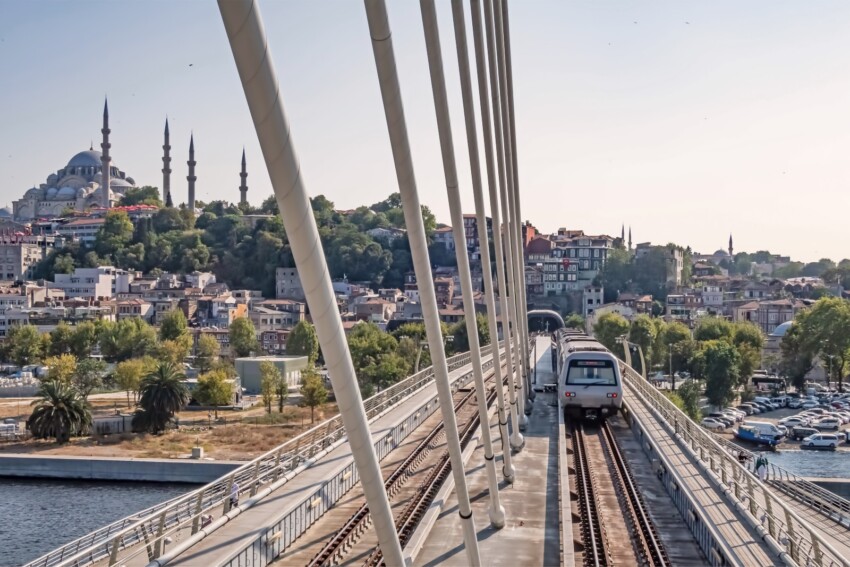
The Istanbul metro is extremely efficient, with service hours generally running from 6 a.m. until midnight and waiting times between trains ranging from 5 to 10 minutes. The metro network comprises eleven lines: lines M1A, M1B, M2, M3, M6, M7, M9 and M11 are located on the European side of the Bosphorus, whilst lines M4, M5 and M8 are on the Asian side. Line M11, one of the most recently opened, is not yet complete and is the line that connects the new Istanbul airport with the city centre.
Marmaray Line
The European and Asian sides of the city are connected via the Marmaray line (Commuter Train B1), an intercontinental suburban railway line that also includes a railway tunnel beneath the Bosphorus Strait. This service links two suburban lines, creating a single route that runs from Halkalı on the European side to Gebze on the Asian side.
Istanbul has an extensive network of city buses boasting over 120 routes, including night and daytime services, covering almost 8,000 stops. The bus is undoubtedly the most economical way to get around Istanbul, but it can be complex and difficult to use, especially for travelling from one side of the city to the other. Moreover, due to the traffic that characterises the city, buses may not be the best solution for getting around Istanbul, particularly during peak hours. Public buses are operated by IETT, the public transport authority, and tickets can be purchased at major stops or at shops displaying the “I.E.T.T. Bilet” sign.
Sightseeing buses
Istanbul also has several companies operating the so-called “hop on hop off” sightseeing buses that allow you to visit numerous attractions across the city. Usually, purchasing a ticket for these buses means spending a reasonable amount (certainly less than getting around by taxi) and choosing a solution that combines some benefits of public transport with features such as flexibility and comfort.
These sightseeing bus routes generally follow a set itinerary with stops at major attractions. You won’t need to study a map to figure out how to reach Taksim Square or Dolmabahçe Palace, as the “hop on – hop off” buses are sure to have a stop nearby!
Other advantages of choosing this type of transport include travelling on double-decker buses with a panoramic roof, plus you’ll have access to an audio guide that can provide you with plenty of interesting information about the city and its history. Furthermore, with sightseeing buses, once you’ve purchased your ticket, you can get on and off as many times as you like during the validity period of your pass.
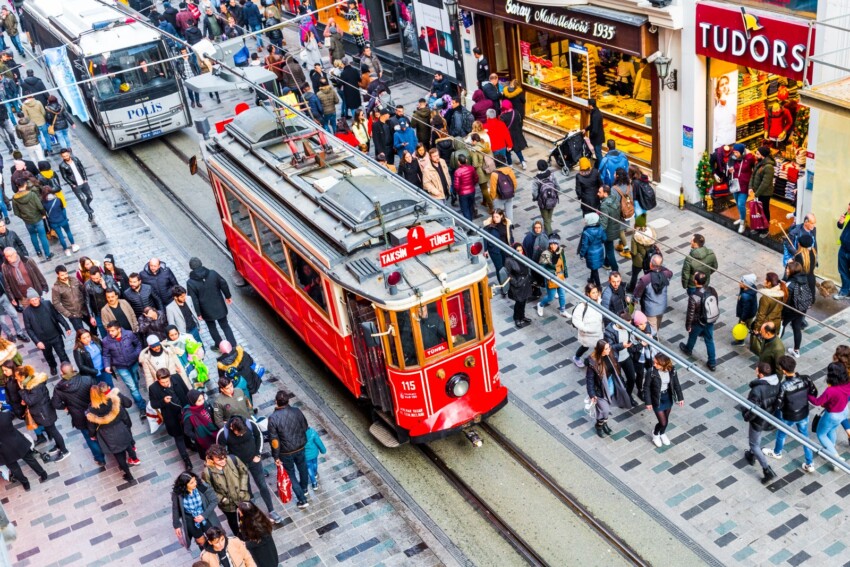
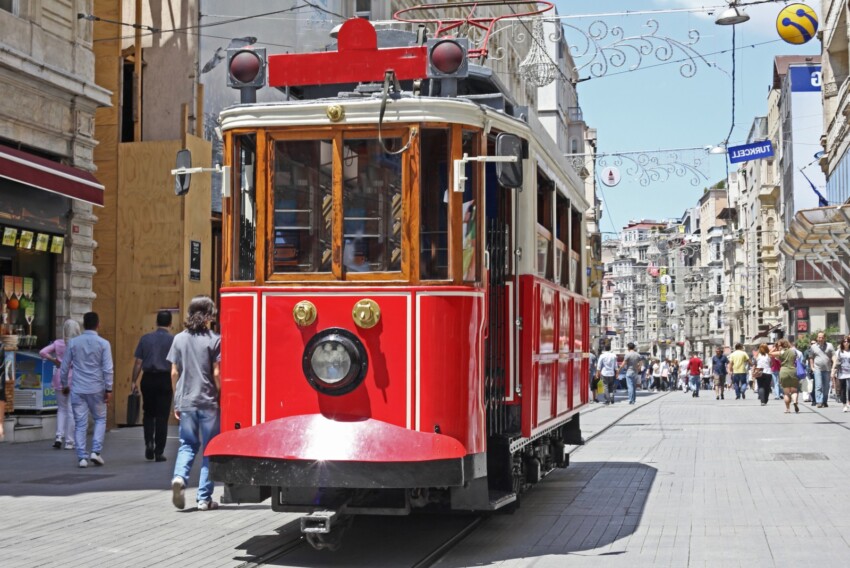
The tram is a very useful way to discover Istanbul, as its routes pass through some of the city’s most popular sites such as the Grand Bazaar, the Blue Mosque, Hagia Sophia and the Spice Bazaar. Istanbul’s tram service operates from 6:00 a.m. to midnight, with trains running every 5 to 10 minutes.
Istanbul’s tram network actually comprises four lines:
T1 Bagcilar – Kabataş
T3 Kadıköy – Moda, the famous “nostalgic tram”
T4 Topkapi – Mescid
T5 Cibali-Alibeyköy
Ferries
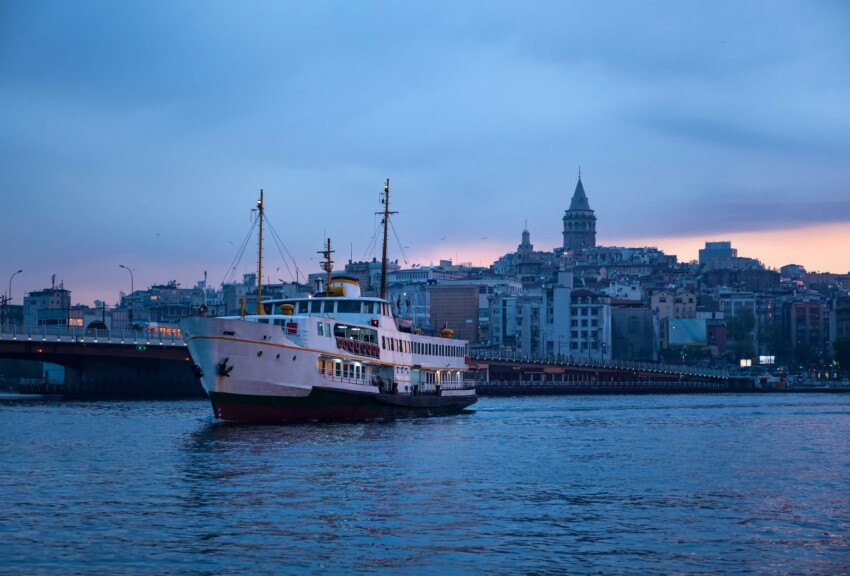
As mentioned earlier, there is no metro line connecting the Asian side to the European side of the city, only the railway line; for this reason, apart from the aforementioned B1 Marmaray commuter train, a network of maritime shuttles has been established to travel between the two continents. Ferry routes are heavily used by locals too, as they are an easy, fast and economical way to get between the shores of the strait.
Istanbul has several ferry terminals on both the European and Asian sides. On the European side, the most important piers are: Eminönü and Karaköy (near the Galata Bridge) and Beşiktaş (between the two Bosphorus bridges). On the Asian side, the most frequently used piers are: Üsküdar (to the north) and Kadıköy (to the south).
Ferry operating hours are more limited than other transport options and differ between summer and winter seasons, but generally these services are active from 7:00 a.m. to 9:00 p.m.
Cable Cars
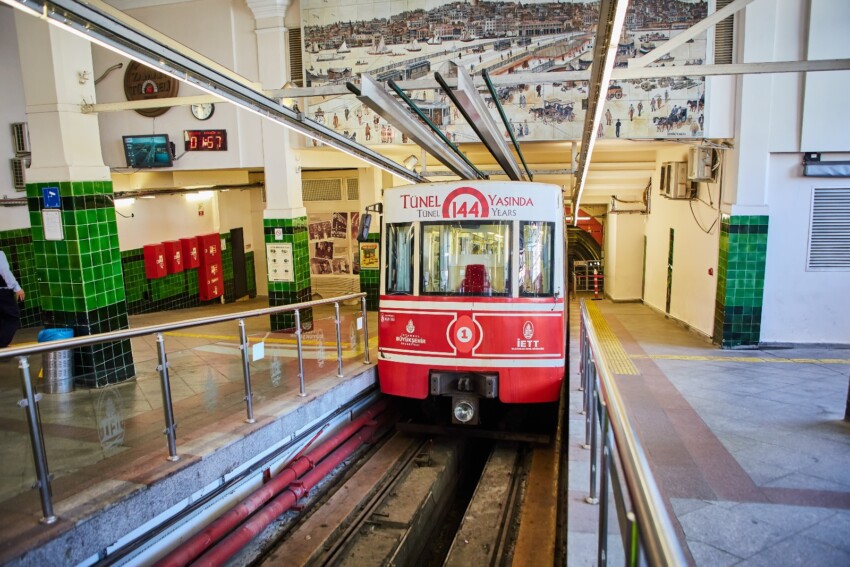
Istanbul has four cable car lines, of which only one (the F3 Vadistanbul-Seyrantepe) operates above ground, while the others are underground. The most famous and popular with tourists is the Karaköy-Beyoğlu Tünel cable car (F2), which, having been inaugurated on 17 January 1875, is the world’s second-oldest underground transport line after the London Underground. It has only two stations (Karaköy and Beyoğlu) and provides an easy and quick link between the Karaköy district and the hillside district of Beyoğlu.
Another important line is the F1 Taksim-Kabataş cable car, which connects Taksim Square with Kabataş, a location in the Beyoğlu neighbourhood where Dolmabahçe Palace is situated. The other two lines are less frequently used by tourists because they cover areas further from the city centre and are: the Seyrantepe F3 cable car and the F4 Boğaziçi Üniversitesi/Hisarüstü-Aşiyan cable car.
Istanbul’s cable cars operate on schedules ranging from 6:00 a.m. to midnight, with trains running every 5 to 10 minutes during the day.
Taxis
Over 17,000 taxis offer a quick and comfortable way to get around Istanbul. The cost is reasonable and it’s a convenient way to travel around the city, although traffic could cause you to lose some time.
If a taxi’s roof light is illuminated, the taxi is ready to pick up a passenger. Additionally, taxi ranks are available at every point in the city and at all stations and airports.
Tickets and Transport Passes
If you like getting around the city using public transport, choose the most convenient or cost-effective way to buy tickets. If you plan to travel sporadically, it will certainly be worth buying individual journey tickets directly once you arrive, but if, on the other hand, you prefer to optimise your time and use public transport without worrying about buying a ticket each time, book online before you leave a City Card or a ticket pack.
Single tickets
A single ticket (called a jeton in Turkish, meaning token) for using Istanbul’s public transport costs 40 Turkish lire and must be purchased before boarding. For the metro, single tickets are purchased at station ticket offices or at automatic machines, whilst for the tram at automatic machines at stops (note: some tram stops are not equipped with machines) or at certain shops and newsagents.
Children up to six years of age travel free. You can also pay with a contactless card, at a cost of approximately 50 Turkish lire per journey.
Istanbulkart
The Istanbulkart is a rechargeable card costing 165 Turkish lire that allows you to use the city’s entire public transport network. With this card you can take the metro, tram, buses and maritime shuttles easily and economically without having to worry about buying tickets each time. Simply swipe the card in the reader at the entrance to each station and with the Istanbulkart each journey will cost approximately 35 Turkish lire (prices vary slightly depending on the transport mode).
The card can be purchased at the airport, at metro stations, at major bus stations and at some ferry terminals. It can be topped up at ticket offices in major stations, at automatic machines or at certain shops and newsagents. This card is also a major advantage for those travelling in a group or as a family, as a single card can be used by up to 5 passengers.
Please note: from 2023, in order to purchase the card you need to provide a Turkish identity number, so it is no longer available to tourists, for whom the new Istanbul City Card is available.
Istanbul City Card
Recently introduced, the Istanbul City Card is a pass for unlimited travel on Istanbul’s public transport, including metro, tram, buses, light metro and ferries, dedicated exclusively to tourists. Depending on the length of your stay, you can choose the duration: it can be valid for 1, 3, 5, 7 or 15 days.
A further advantage of this card is that you can receive it free of charge directly at your Istanbul hotel.
Moreover, if you’ve planned a multi-day trip to Istanbul with the intention of visiting all the most famous attractions, perhaps using public transport more than once, then it’s worth considering purchasing the Istanbul Tourist Pass. This is a solution specifically designed for tourists or for those staying in the city for a limited period, as it allows you to use public transport and visit major attractions at truly reasonable prices.
Available for 1, 2, 3, 4, 7 or 10 days, the pass provides free or discounted entry to over 100 attractions, discounts at numerous shops and restaurants, activities such as a Bosphorus cruise or a whirling dervishes show, and a “skip the queue” option at various sites.


 Hotel
Hotel  Budget accommodations
  Apartments
  Family Hotel
  Luxury Hotel