Cappadocia: Goreme Hot Air Balloon Flight at Sunrise
5.019 reviews
Buy now
From 120,00€ per person

Istanbul is a wonderful city that offers countless attractions, historic monuments and religious buildings as well as traditional bazaars, cultural sites and excellent restaurants serving local cuisine. There are many things to do and see, and given the city’s size and the location of certain attractions, it’s always best to plan an itinerary of the sites you wish to visit to optimise your time and travel.
With extra time available, you can also organise excursions to explore the areas surrounding Istanbul, which are equally interesting and rich in heritage. The city is home to numerous travel agencies that organise trips to discover other Turkish destinations, whilst many hotels also offer the same service and can arrange wonderful tours. You can organise various types of activities and excursions, some lasting just a few hours whilst others spanning one or more days with accommodation and transfers included.
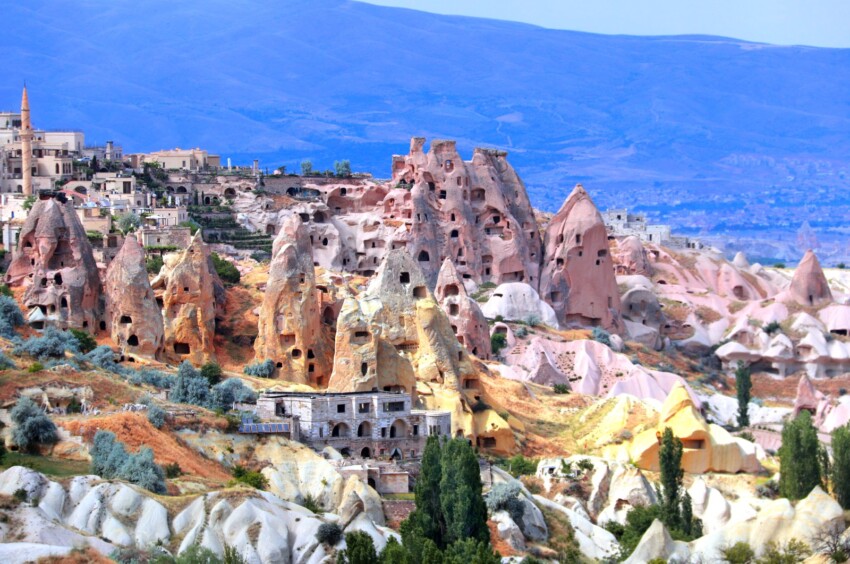
During a trip to Istanbul, many visitors also want to visit Cappadocia, a region with millennia of history and breathtaking landscapes. Several tours include at least three days in Cappadocia to visit the most important sites, but for those with limited time, it’s possible to explore part of the region in a day trip from Istanbul. These tours depart early in the morning by plane, flying to Kayseri airport, from where the journey begins to Göreme Park, an open-air museum featuring the famous “Fairy Chimneys”.
Over the centuries, truly unique and extraordinary rock formations have formed here, resembling towers or chimneys that, according to some local traditions, were inhabited by fairies and legendary beings – hence the name “Fairy Chimneys“. These formations were used by people, especially Christian hermits, as places of prayer and meditation, particularly between the 10th and 12th centuries when Cappadocia had become an important religious centre. The history of this place and its charm led UNESCO to declare this site a World Heritage Site.
If desired, you can also arrange a stunning hot air balloon flight allowing you to admire the entire landscape from above.
Bursa was the capital of the Ottoman Empire between 1326 and 1365; afterwards, this title was transferred first to Edirne and then to Istanbul. Long known as an important commercial hub, the city stood along the Silk Road and was therefore frequently visited by merchants and traders. For several centuries, the city has been home to a Grand Bazaar (Kapalı Çarşı), a covered market where you can find numerous items, particularly textiles and silk products, as the city was famous for processing this material.
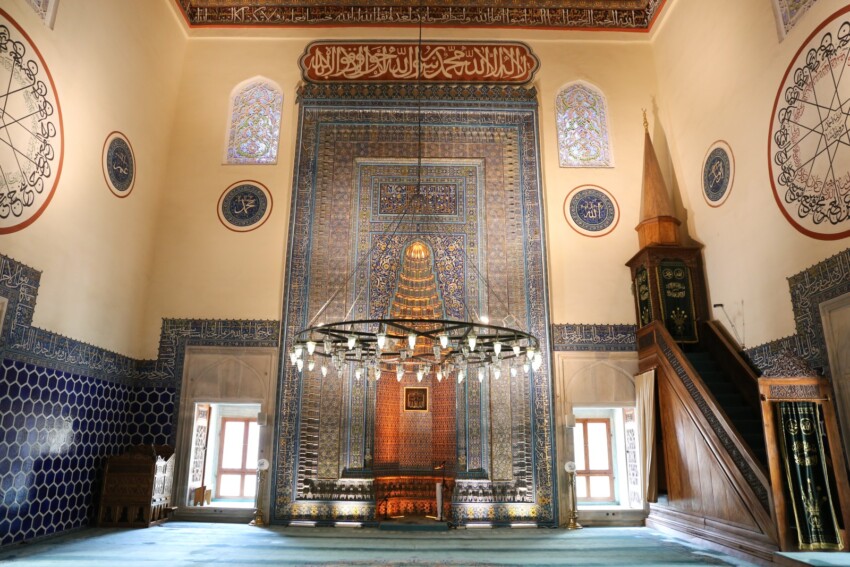
Bursa is located south of the Sea of Marmara at the foot of Mount Uludağ (ancient Olympus of Mysia) and preserves a vast heritage related to Ottoman architecture. Don’t miss a visit to the Grand Mosque, built in 1399, which can accommodate up to 5,000 worshippers inside and features twenty domes. Another essential stop is a visit to the Green Mosque (Yeşil Camii) and its adjacent mausoleum, which houses the tomb of the fifth Ottoman sultan, Mehmed I, who reigned from 1413 to 1421.
Edirne is a city in north-western Turkey, near the border with Greece, and served as the second capital of the Ottoman Empire until 1453, after Bursa, before Istanbul was chosen for this role. Numerous traces of the Ottoman past remain here, including several mosques and numerous caravanserais that served as lodgings for merchant caravans travelling the Spice Route.
The Selimiye Mosque, built in the 16th century during the reign of Selim II, is particularly noteworthy and is considered a masterpiece of Ottoman architecture, having been included in UNESCO’s World Heritage Sites. In the oldest part of the historic centre (Kaleiçi), you’ll find the ancient Bazaar, a place to purchase typical products, souvenirs and locally made items. Edirne is also home to various churches (of both Catholic and Orthodox rites) and a large synagogue built in the 20th century after a fire had destroyed several of the city’s synagogues.
130 km south-east of Istanbul lies the town of Iznik, formerly known as Nicaea, which can be reached either by car (approximately two hours) or by ferry (around one hour). The town is particularly renowned for hosting two ecumenical councils of Christianity: the first convened by Emperor Constantine I in 325 and a second called by Empress Irene of Athens in 787. Once surrounded by a long city wall, some remnants remain, such as the Lefke Gate (east) and Istanbul Gate (north), which provide access to the oldest area.
In Iznik you can still admire beautiful mosques, the Obelisk (Dikilitaş), madrasas and numerous production workshops of the famous Iznik tiles, a product renowned and exported worldwide. Also worth visiting is the Green Mosque, built in the late 15th century and considered the symbol of the town because of its minaret decorated with turquoise and green tiles. Another important site contains the remains of the Hagia Sophia Mosque, once built as a church that also hosted the sessions of the Council of Nicaea in 787. With the Ottoman conquest, this building was converted into a mosque and was later partially destroyed in 1920 by vandals.
Perfect for a day excursion are certainly the Princes’ Islands, an archipelago in the Sea of Marmara consisting of nine charming islets. These prove to be the ideal escape from the hustle and bustle of the city, as they can largely be explored only on foot, by bike or on horseback, since cars are not permitted here. The largest of the nine islands is Büyük Adası (Büyük Island), which boasts not only beautiful beaches for sunbathing but also a vibrant centre with shops, craft workshops and restaurants.
For those wishing to take a Princes’ Islands tour, the second ferry stop is typically Burgaz Adası (Burgaz Island), which is the third largest in the entire archipelago. This island has a peaceful, relaxed atmosphere, and at times even romantic, and it’s pleasant to stroll along the waterfront area where you’ll find numerous hotels, restaurants and bars. Here, many Jewish families in the 19th century built wonderful residences, some of which remain privately owned and others have been converted into commercial establishments. Additionally, there are small beaches and coves scattered along the island’s coast, which are ideal for those wishing to spend hours relaxing and sunbathing.
Another interesting day trip from Istanbul is to the city of Troy, known to everyone for the famous “Trojan War” recounted in Homer’s Iliad and thus a destination steeped in stories and legends. The city is reached via a splendid journey that also includes crossing the Dardanelles Strait by ferry to Çanakkale. Not everyone knows that in the area corresponding to the city of Troy, experts have actually found evidence pointing to the existence of nine different cities built here over the centuries.
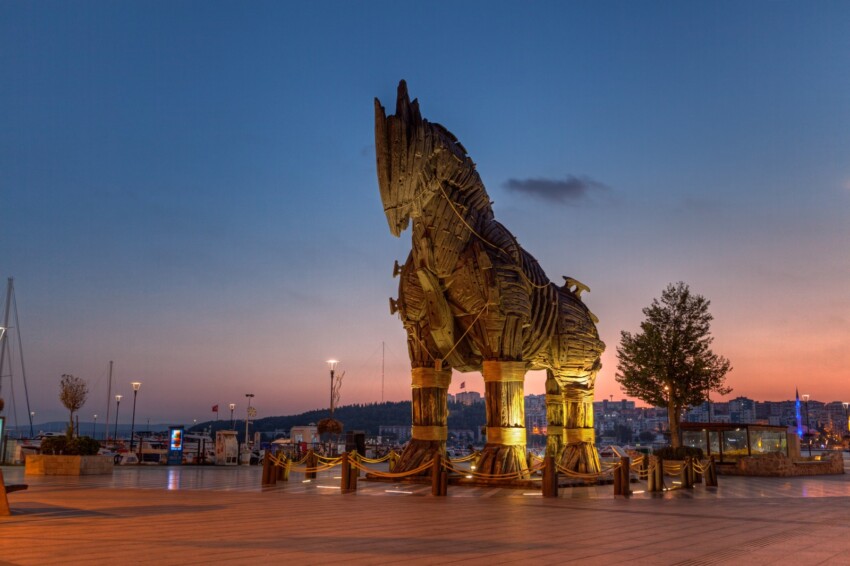
The archaeological site now preserves various remains thousands of years old, such as the city wall, built to defend the territory from enemy attacks and mentioned by Homer himself, and the Gate of Troy, which marks the starting point of the exploratory route. Continuing on, you can also admire the remains of the Temple of Athena and Priam’s House, a large complex that was likely the very residence of the famous Trojan king. During your visit, you can’t help but notice a reconstruction of a large wooden horse, created to commemorate the one used by the Achaeans during the war and employed to conquer the city and win the conflict.
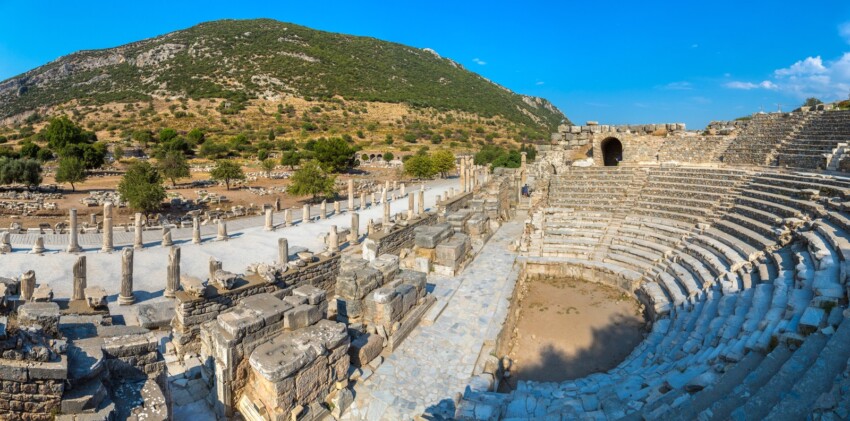
Another highly interesting tour that can be organised as a day trip from Istanbul is undoubtedly the one to the town of Ephesus, which currently houses one of the most important archaeological sites in all of Turkey. The city of Ephesus has a long history, and its territories have undergone various periods of rule, including Greek, Roman, Byzantine and Ottoman, because due to its location Ephesus was always an important commercial centre.
The ancient city comprised a large agora and two main districts, one dedicated to political and religious life and the other reserved for leisure, relaxation and entertainment. Here you can follow a route discovering the history of ancient Ephesus, admiring important buildings from that era such as the Library of Celsus, the Odeon, the great Theatre and the splendid Temple of Hadrian.
Moreover, on the same day it’s possible to visit the Temple of Artemis, which is located just over 3 km from Ephesus. This was first built around the 6th century BC but was reconstructed many times and was always famous for its imposing size and importance. It is estimated that the Temple of Artemis could have been much larger than the Parthenon in Athens and was therefore considered one of the Seven Wonders of the ancient world.
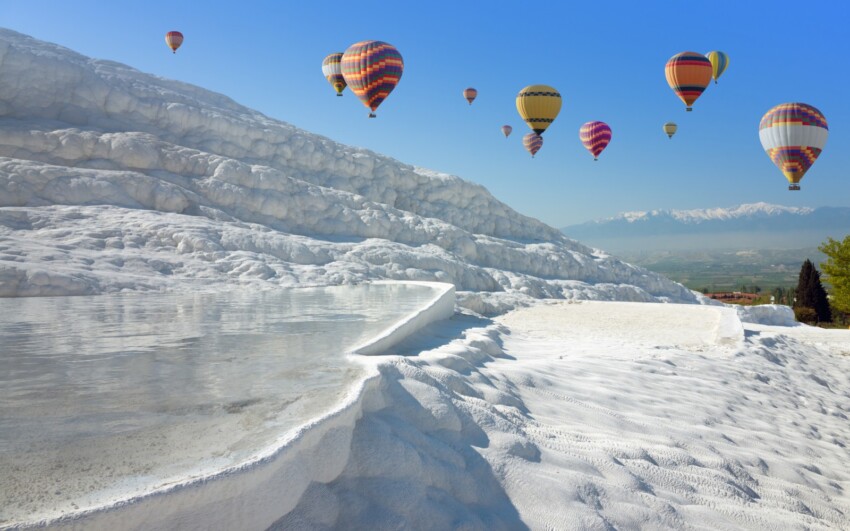
Another splendid natural masterpiece in Turkey is undoubtedly the natural pools of Pamukkale, which rise in the Aegean region and can be reached in a day trip by plane from Istanbul to Denizli airport. At Pamukkale, over the years, mineral-rich waters flowing down the slope of the hillside have left behind deposits of limestone and travertine, creating special white-coloured formations in the terrain.
From these special formations came the name “Pamukkale”, which in Turkish means “cotton castle”. This has created special pathways allowing you to visit these natural white travertine pools, although you can no longer immerse yourself in them. Years ago, various accommodation facilities exploited these particular springs, and by allowing tourists to bathe in them, they particularly damaged this fragile ecosystem.
Near Pamukkale, moreover, lies Hierapolis, which was a thriving Greco-Roman city considered an important health and wellness centre thanks to its thermal springs. In this location you’ll find an archaeological site with well-preserved ruins, including a large theatre, a necropolis and several temples. Pamukkale and Hierapolis together were declared a UNESCO World Heritage Site in 1988.
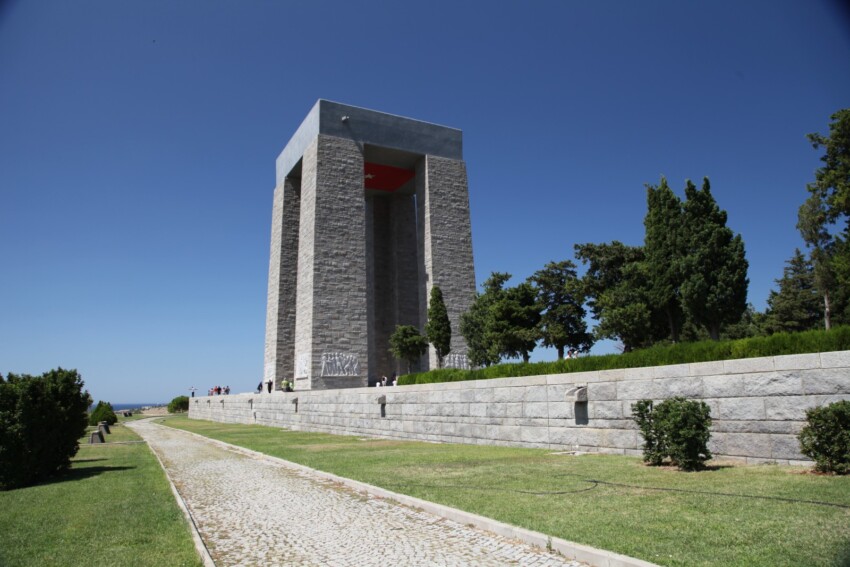
On the European side of the Dardanelles Strait lies the town of Gallipoli, in a location long considered strategically important for commercial and military routes. Unfortunately, over the last century, the town has become known for the tragic events and numerous deaths that occurred here during World War I, when Allied forces occupied the area to open a supply route to Russia via the Black Sea, hoping thereby to force the Ottoman Empire to surrender. The campaign, lasting less than a year (from April 1915 to January 1916), resulted in heavy losses for both sides but ultimately the Ottomans prevailed.
You can therefore visit the landing beaches in this area, several cemeteries where military personnel were buried (including that at Ariburnu) and the Anzac (Australian and New Zealand Army Corps) memorial site erected in honour of the Australian and New Zealand troops who fought here alongside the British and French. Among the historic sites to admire is the Kilitbahir Fortress, built in 1462 at the behest of Sultan Mehmed II to defend the Dardanelles Strait. Inside, a museum has now been opened recounting much of the history of the birth and successes of the Ottoman Empire.
To escape the hustle and bustle of a sprawling city like Istanbul, there’s nothing quite like a leisurely cruise across the Bosphorus, taking in the city from an entirely different perspective. By boat, you can reach the charming fishing village of Garipce, nestled at the foot of a hillside in the Istanbul Strait along the shores of the Black Sea. This is a popular spot amongst locals and visitors alike, renowned for its excellent seafood restaurants and its wonderfully peaceful, relaxed atmosphere.
Notable sites in the area include Rumeli Fortress, which overlooks the Bosphorus and was built in the 16th century by the Genoese, and a 17th-century castle from which you can enjoy breathtaking views across the water.
City Card allow you to save on public transport and / or on the entrances to the main tourist attractions.

 Hotel
Hotel  Budget accommodations
  Apartments
  Family Hotel
  Luxury Hotel