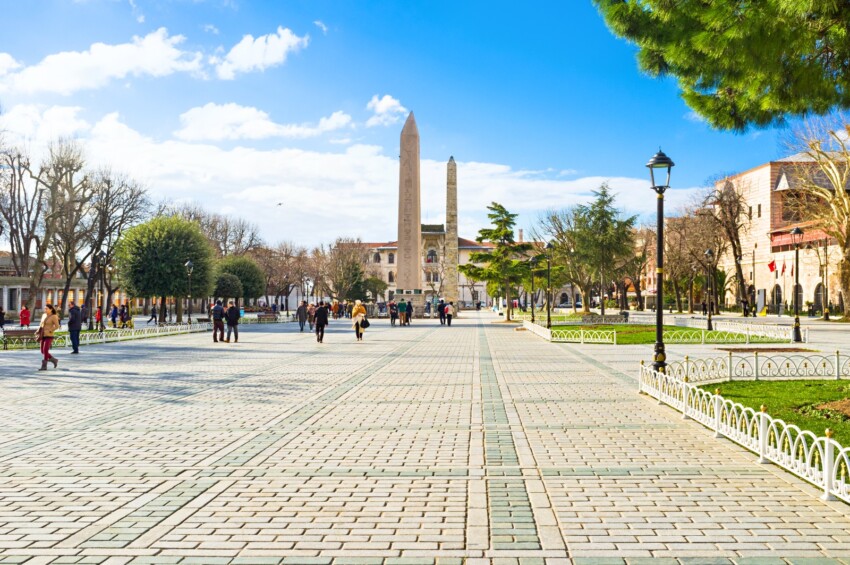
Known in Turkish as “Atmeydani”, meaning the Square of Horses, the Roman Hippodrome in Istanbul was an enormously important site in the city’s history. Originally built as a venue for chariot races, it later became the stage for political power struggles and civil unrest. The carceres (starting gates) were positioned at the northern end and crowned with four gilded bronze horse statues, now called the Horses of St Mark because they stand on the façade of the Basilica of St Mark.
The Hippodrome sits just beside the Blue Mosque, though over the centuries and through various occupations, it has lost much of its grandeur and decorative elements, making its original purpose nearly unrecognisable today. Beyond being plundered repeatedly, the Hippodrome was also quarried for marble to build mosques and later served as a bus station before finally being transformed into public space.
Once considered the true heart of the city, the Istanbul Hippodrome was a venue for popular entertainment on a monumental scale, second only to Rome’s Circus Maximus. Stretching nearly 400 metres long and 130 metres wide, it could accommodate around 100,000 spectators who gathered here for chariot races. Over time, however, it evolved into a place where festivals, public gatherings and occasionally rebellions took place.
The site has retained only the remains of the ancient hippodrome’s arcades and other monuments of considerable interest, such as the German Kaiser’s Fountain and the Obelisk of Theodosios. Unfortunately, the Hippodrome was stripped of many of its decorative elements over the centuries, including the famous Horse statues which were looted during the Fourth Crusade by the Venetian Republic and taken to Italy, where they remain today.
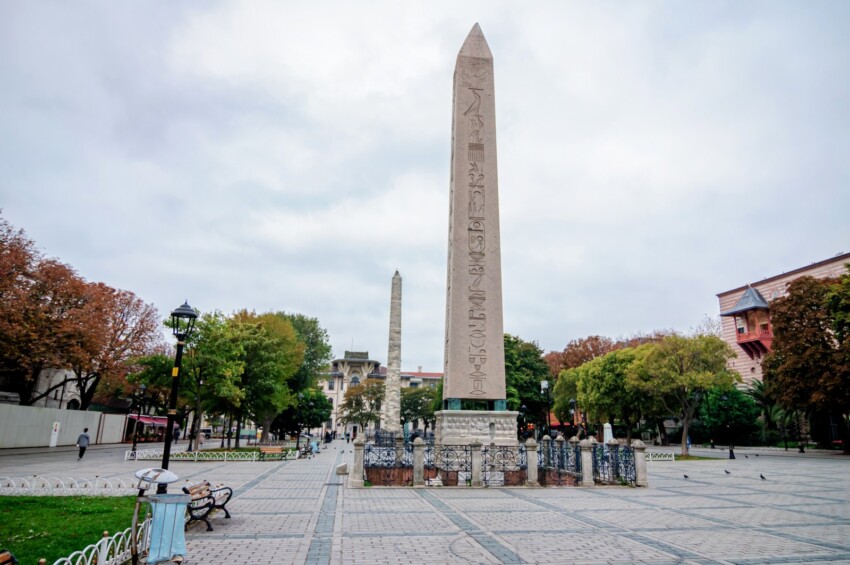
Created by Pharaoh Thutmose II 3,500 years ago, this Obelisk was later brought to Constantinople by Theodosios I (379-395) during his military campaigns. Originally standing over thirty metres tall, the obelisk was damaged, probably during transport, and now stands at just 25.6 metres including its base. Carved from red Aswan granite (Syene), the obelisk’s four faces are inscribed with hieroglyphics depicting the life and deeds of Pharaoh Thutmose. The marble base, also known as the Theodosios Plinth, features numerous relief carvings executed when the obelisk was erected in Constantinople, representing various achievements of the Emperor Theodosios I.
The Serpentine Column is a bronze column standing approximately 8 metres high, originally erected at the Temple of Apollo at Delphi before being relocated to Constantinople. Its origins are uncertain, but it is known to have been erected as a commemorative sacrifice celebrating the Greeks’ victory over the Persian Empire at the Battle of Plataea (479 BC). According to various sources, the column was an ancient Greek tripod transported to the city in 324 AD by the Emperor Constantine. Regrettably, the pillar has lost two of its three heads entirely, whilst the remains of the third are preserved in Istanbul’s Archaeological Museum.
When Emperor Constantine I ascended the throne in 306 AD, a porphyry column was erected in the forum of the new capital, Constantinople. Originally 50 metres tall, it now stands only 35 metres due to various damages and repairs. It was originally topped with a statue of the emperor holding a spear in his left hand and a cross in his right, crowned with a seven-rayed diadem. The statue’s gaze was directed eastward, and the column bore the inscription: “Constantine, who shines like the sun”. Sadly, the imperial statue has been lost over time, and the column has suffered considerable damage and reconstruction.
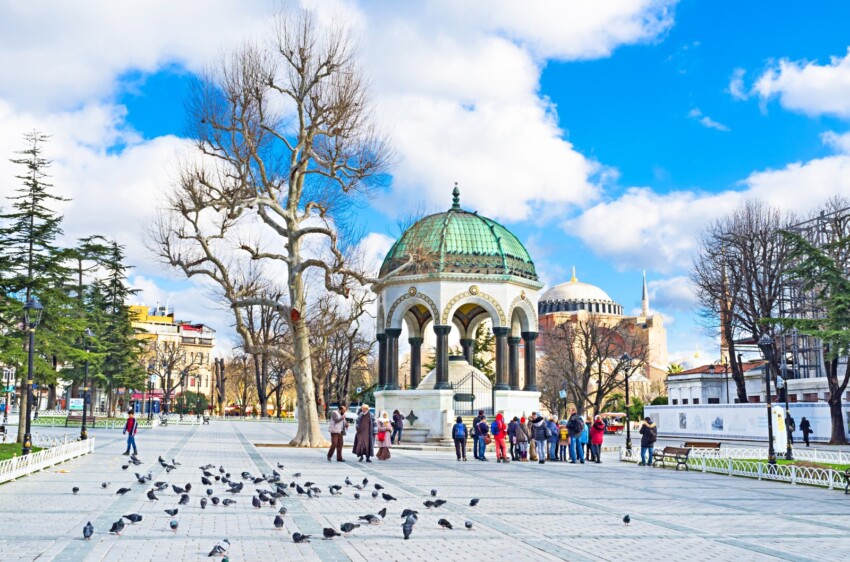
The German Fountain (in Turkish, Alman Çeşmesi) is a gazebo-style fountain located at the northern end of the Hippodrome, erected to commemorate the second anniversary of German Emperor Wilhelm II’s visit to Istanbul in 1898. The fountain was constructed entirely in Germany, transported to Turkey piece by piece, and assembled on site in 1900. A distinctive feature of the monument is its octagonal dome in neo-Byzantine style, crowned with eight marble columns, whilst the interior is adorned with mosaics and gold decoration bearing Wilhelm II’s monogram.
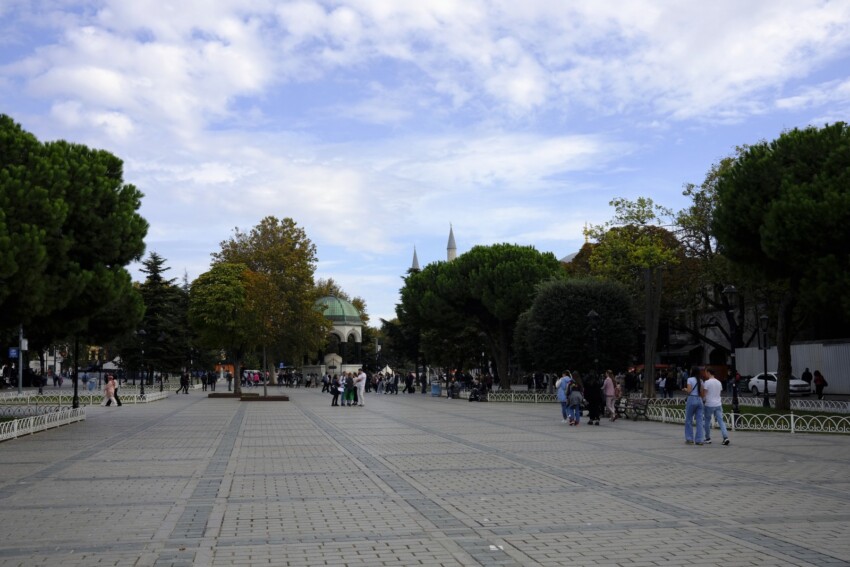
Built around the 3rd century AD by Emperor Septimius Severus, the Istanbul Hippodrome assumed its present form and monumental proportions under Constantine I, who modelled it on Rome’s Circus Maximus and sought to transform Constantinople into a “New Rome”. Around the entire structure stood statues of gods, emperors, animals and heroes, though these were destroyed or lost over time. The hippodrome, which could hold up to 100,000 people, allowed the populace to see the emperor seated in the imperial box (known as the Kathisma), which was connected to the Imperial Palace by secret passages. The hippodrome was far more than a venue for chariot racing and spectacles; it was where popular unrest could spark, and emperors could lose their thrones during riots triggered by races. During the Byzantine period, the hippodrome reflected the city’s social composition: the poor occupied the right side, forming the Blue faction, whilst the left side held the Greens, comprising the urban bourgeoisie.
Over the centuries, this site witnessed numerous protests and rebellions, most notably the Nika Riots, when dissidents sought to topple Emperor Justinian. During this rebellion, Istanbul was devastated and the Basilica of Hagia Sophia was occupied and damaged. Only after nearly seven days did General Belisarios manage to suppress the rioters, executing approximately 30,000 people right at the Hippodrome. Over time, the Hippodrome lost some of its role as a gathering place and became a quarry for materials used in constructing other buildings. What it never lost, however, was its function as a flashpoint for political upheaval, notably sparking the disturbances that in 1909 led to the fall of Caliph Abdul Hamit II and the promulgation of the first Ottoman Constitution.
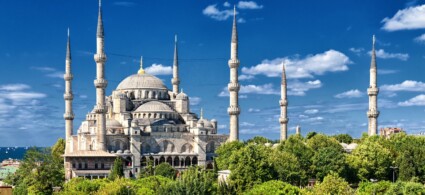
The Hippodrome stands in the heart of old Istanbul in the Sultanahmet district, just beside the Blue Mosque. To reach it by public transport, take the T1 tram line to Sultanahmet station and walk a few metres from there to this grand public space. If you’re at Taksim Square, first take the F1 funicular to Kabatas, then the T1 tram to Sultanahmet station.
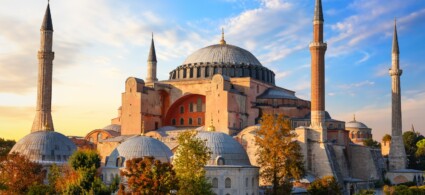
The Roman Hippodrome stands in one of the city's most central and ancient areas, surrounded by other monuments of considerable interest such as Hagia Sophia, the Blue Mosque, the Hippodrome and Topkapi Palace.
City Card allow you to save on public transport and / or on the entrances to the main tourist attractions.


 Hotel
Hotel  Budget accommodations
  Apartments
  Family Hotel
  Luxury Hotel