Bestseller
Istanbul: Hagia Sophia Skip-the-Line Ticket & Museum Option
From 28,00 €
Buy the ticket
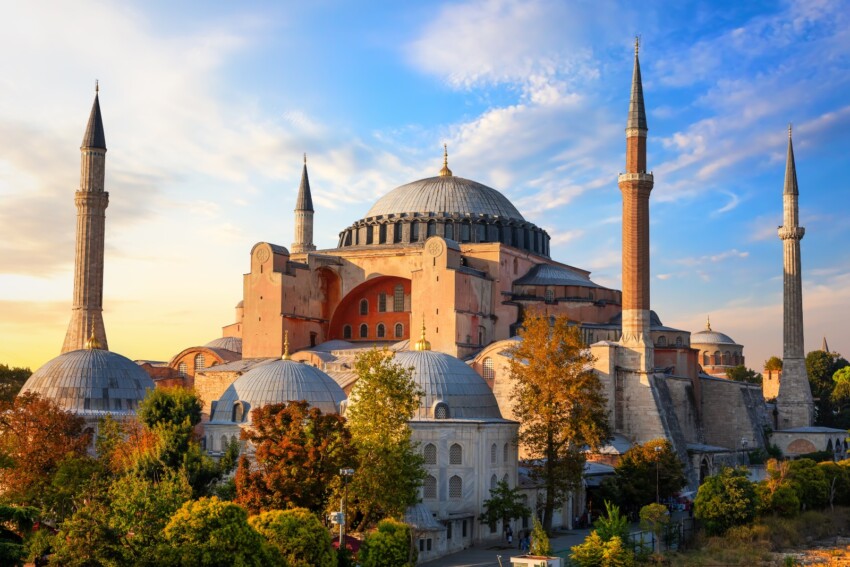
Who, upon mentioning Istanbul, doesn’t immediately think of Hagia Sophia, a masterpiece of Byzantine architecture and one of the symbols of this Turkish city? Hagia Sophia is also known as the Aya Sofya, and its history is long and sometimes turbulent, much like Istanbul itself. Historical records show that a church had been constructed in this area as early as the 4th century AD, but it was destroyed. The building we can admire today was commissioned in 537 AD by Emperor Justinian I. The emperor called upon the finest architects and engineers and used materials sourced from across the empire to build what was to become the largest basilica in Christendom.
Known as the Basilica of the Holy Wisdom, the complex was completed during the reign of Emperor Justinian II and remained for many years the city’s greatest place of worship, with interiors considered magnificently splendid. Regrettably, several earthquakes have struck Istanbul over the centuries, and the Basilica has sustained considerable damage and loss. Added to this are fires and devastations that occurred throughout the ages, which stripped it of reliquaries and artefacts of considerable interest and value.
With Mehmed the Conqueror’s capture of Constantinople, the Basilica of the Holy Wisdom was converted into the mosque of Aya Sofya and underwent various restoration and maintenance works. The building remained a place of Islamic worship until 1935, when Mustafa Kemal Atatürk, founder of the Turkish Republic, decided to transform it into a museum open to the public. Hagia Sophia was subsequently reconverted to a mosque in 2020 by order of President Erdoğan.
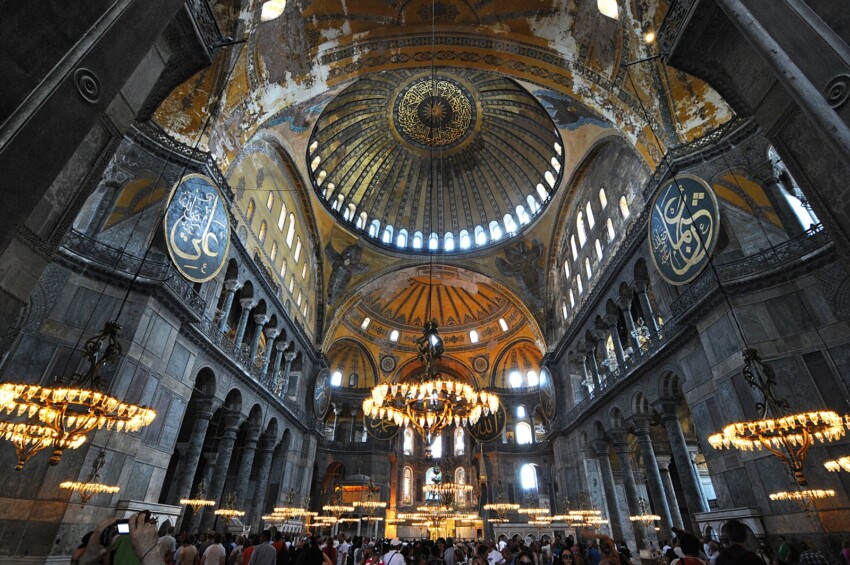
Designated a UNESCO World Heritage site, Hagia Sophia is today known as the Blessed Great Mosque of Holy Wisdom or the Basilica of the Holy Wisdom and is an absolute must-see during a visit to Istanbul. Externally, the building impresses with its sheer majesty, with minarets that call the faithful to prayer, whilst internally all visitors are mesmerised by its decorations.
The building features a basilical layout likely derived from Constantine’s basilica, with a grand central nave, two side aisles and a single polygonal apse on the exterior. The central nave is crowned by a vast dome standing 55.6 metres high, pierced by 40 arched windows that create captivating play of light. The dome is not only breathtaking but also of particular interest to architects and engineers for its innovative design—it rests not on solid masonry but is supported by four pendentives.
Inside the building, you’ll notice that many of the columns between the naves are partly fashioned from green marble from Thessaly and feature elegant decorations. The walls display numerous golden mosaics composed of approximately 30 million tesserae and remnants of frescoes largely lost or disappeared. Outside, don’t miss the ancient Baptistry, which over time was transformed into a sepulchral chamber for several sultans. Here lie the tombs of Selim II, Murad II and Mehmed III, alongside the magnificent octagonal ablution fountain crowned with a dome.
As it is a mosque, entry to Hagia Sophia is free; however, given the lengthy queues at the entrance, we recommend purchasing a fast-track entry ticket with a guided tour.
Moreover, if you’re planning to visit other city attractions, such as the Blue Mosque and the Basilica Cistern, or embark on an unmissable Bosphorus cruise, consider purchasing a city card.
Hagia Sophia is open daily from 09:00 in the morning until 22:00 in the evening. As the building is now a mosque, during prayer times certain areas are closed and reserved exclusively for the faithful.
Note that appropriate dress is required for entry—trousers at least knee-length and shoulders covered; additionally, women must also have their head covered and avoid low necklines or revealing clothing. Before entering, you must also remove your shoes.
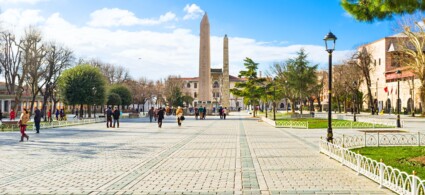
Hagia Sophia is located in Sultanahmet Square, which was the heart of ancient Constantinople and is easily accessible on foot or by public transport or taxi. Those travelling by public transport from the Galata district can take the T1 tram line and alight at the Sultanahmet stop; from Taksim Square, you’ll first need to take the F1 funicular to Kabataş and then the T1 tram to the Sultanahmet stop.
During the tram journey, you’ll pass iconic Istanbul landmarks such as the Galata Bridge and the Spice Bazaar before reaching the Sultanahmet tram stop, situated right alongside the square itself, which is entirely pedestrianised. Those opting for a taxi will be dropped at the entrance to the pedestrianised area and will then need to walk a few metres on foot.
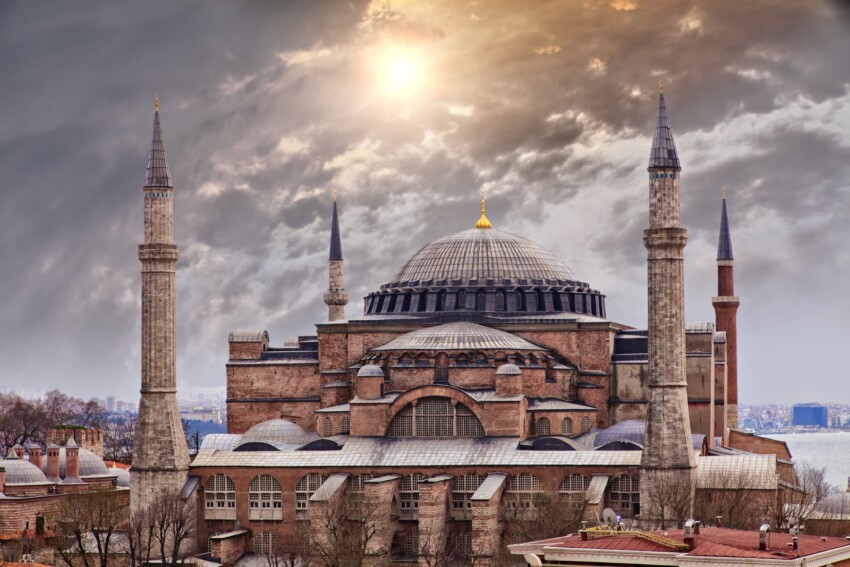
Dedicated to the Holy Wisdom—the Divine Wisdom—this magnificent structure is considered one of the finest examples of Byzantine architecture. The first Church of the Holy Wisdom in Istanbul, known simply as the Great Church, was built around the 4th century by Constantine and was a religious edifice with a basilical layout and wooden roof.
This complex was unfortunately destroyed by fire, and another church was built in its place, but it too was destroyed in 532 AD during the Nika riots. Thus, in 537 AD, Emperor Justinian I ordered the construction of a grand Basilica designed to be truly magnificent in scale.
The finest architectural minds were engaged for its construction, including the Greek architects Anthemius of Tralles and Isidore of Miletus. Once completed, Hagia Sophia became not only the seat of the Patriarch of Constantinople but also the venue for the coronation ceremonies of Byzantine emperors. Over the years, regrettably, the Basilica was repeatedly struck by earthquakes and plundered during the Crusades, necessitating several restoration projects, particularly to the dome, which was always regarded as its most beautiful yet also most vulnerable element.
In 1453, Mehmed the Conqueror took Constantinople, and from that point forward the Basilica was transformed into a mosque, to which minarets were added whilst the interior wall mosaics were plastered over in accordance with Islamic teachings. In subsequent centuries, further earthquakes damaged the mosque, and so in the 19th century Sultan Abdul Mejid I commissioned a major restoration undertaken by the brothers Gaspare and Giuseppe Fossati.
In 1935, Mustafa Kemal Atatürk, first president and founder of the Turkish Republic, decided to convert Hagia Sophia into a museum so that all could contemplate this architectural masterpiece. In 2020, however, President Erdoğan again changed the status of Hagia Sophia, restoring it from museum to a place of Islamic worship.
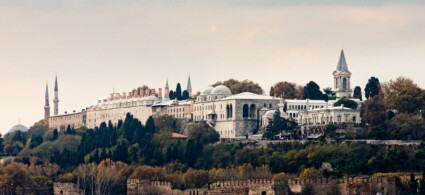
Hagia Sophia is located in Sultanahmet Square, a central area of Istanbul home to several other major attractions including the Blue Mosque, the Hippodrome and Topkapi Palace.
City Card allow you to save on public transport and / or on the entrances to the main tourist attractions.


 Hotel
Hotel  Budget accommodations
  Apartments
  Family Hotel
  Luxury Hotel