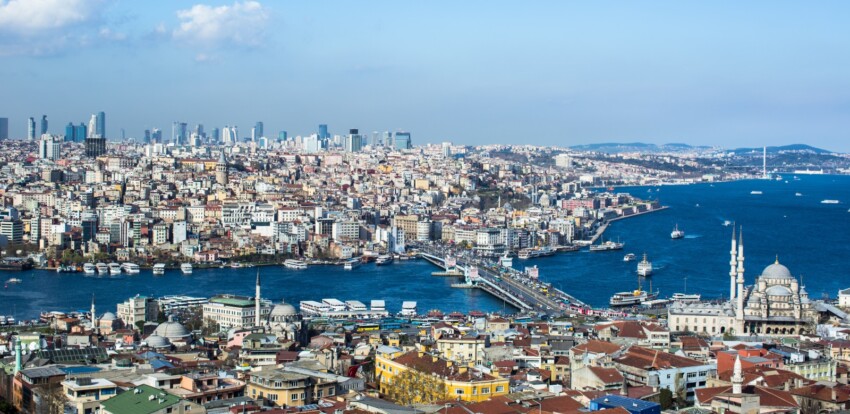
The Galata Bridge (Galata Köprüsü) is far more than just an impressive piece of infrastructure – it’s a vital link that once connected Istanbul’s old quarter, home to the principal Ottoman political and religious institutions, with the city’s European district.
The Galata neighbourhood is the historic heart of Beyoğlu, an area in the northern part of the Golden Horn, which for centuries fell under both Genoese and Venetian control. Galata was once the seat of embassies, European palaces, financial institutions and churches, and served as home to foreign diplomats and merchants.
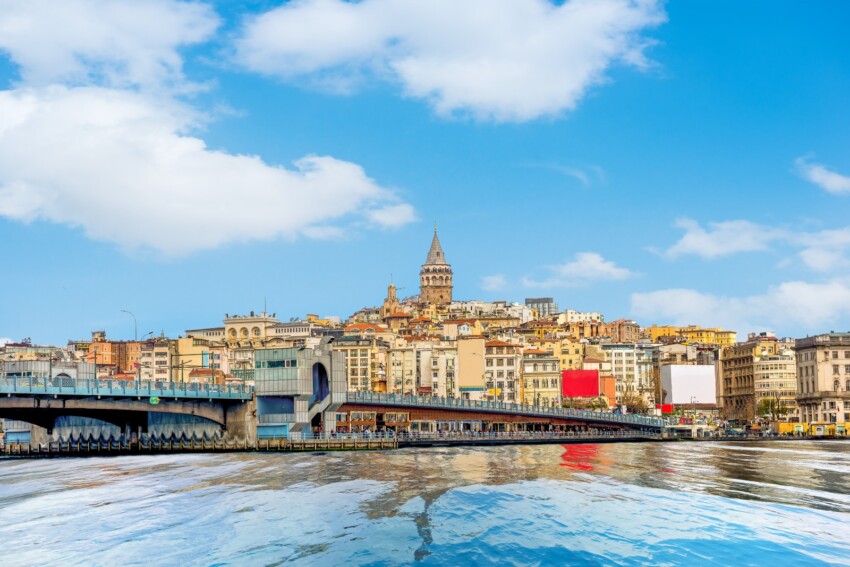
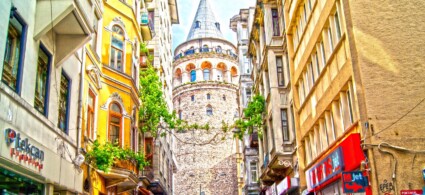
The Galata Bridge ranks among Istanbul’s most iconic landmarks and shouldn’t be missed during a city visit. Stretching 490 metres long and 25 metres wide, the structure accommodates cars, trams and pedestrians alike, and we’d heartily recommend crossing it to move between Istanbul’s quarters, especially if you’re heading to the Galata Tower, perched atop a hillside. Walking across the bridge offers a chance to observe the multicultural diversity that thrives in Istanbul, a city that served as capital to numerous great empires and as a crossroads of ancient trade routes.
The current bridge was constructed in the early 1990s and features a retractable design with three lanes in each direction for vehicles and trams, plus a pavement on either side. Beneath the bridge’s road level, a vibrant pedestrian area was created in the 2000s, filled with cafés, bars and restaurants where you can pause for refreshment whilst soaking up the city views. The bridge itself is beautifully illuminated in the evenings, when its lights create a captivating spectacle visible from numerous vantage points across Istanbul.
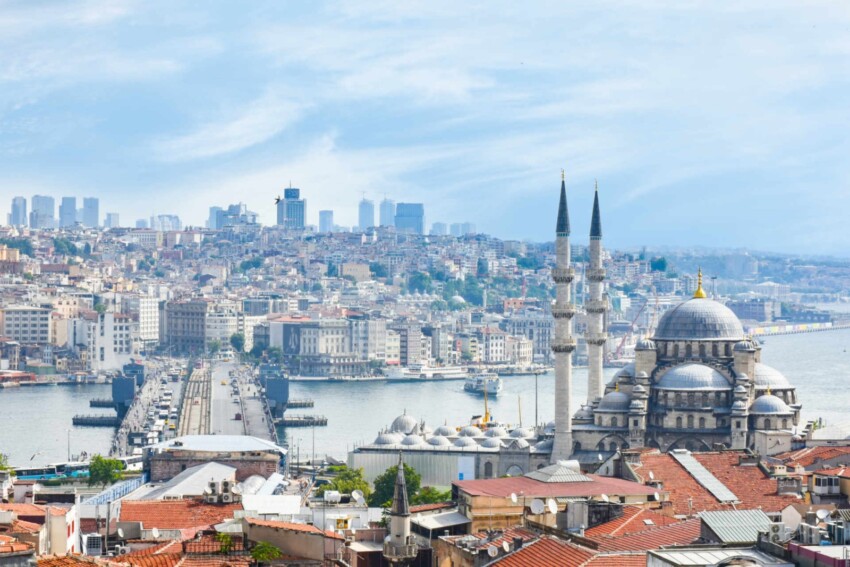
The idea of connecting these two parts of the city first emerged in 1502-1503 when Sultan Bayezid II commissioned Leonardo da Vinci to design a bridge linking Seraglio Point (on the Golden Horn) with Beyoğlu. Leonardo proposed a single-span bridge measuring 360 metres long and 24 metres wide, but Sultan Bayezid II rejected the concept. Nevertheless, the sultan preserved Leonardo’s proposal, which was later discovered in the Topkapi Palace archives. Michelangelo was subsequently invited to submit his own solution, but his design too was turned down, and no bridge was built until the 19th century.
Finally, the first wooden bridge at the entrance to the Golden Horn was constructed in 1845 at the behest of Valide Sultan Bezmiâlem, mother of Sultan Abdülmecid I. This structure was repeatedly destroyed and rebuilt until 1912, when the first bridge with a metal framework was erected – it stood until 1992 when fire damaged it severely. The bridge we see today is thus a reconstruction completed between 1992 and 1994, and functions as a retractable bridge accommodating vehicles, tram lines and pedestrians.
From Sultanahmet, you can reach the Galata Bridge by tram in approximately 12 minutes, alighting at Eminönü and crossing the bridge on foot. Alternatively, you can take the tram across the bridge and get off at the next stop, Karaköy, on the opposite side of the strait. From Taksim Square, take either the T2 tram line or the M2 metro to reach Galata Tower, then walk down to the bridge. Another option from Taksim Square is to take the F1 line to Kabataş, then board the T1 tram to either Karaköy or Eminönü.
The Galata Bridge spans the Golden Horn and connects Istanbul's oldest quarter, Fatih, with the more modern, Westernised district of Beyoğlu. The bridge lies approximately 2 km from Sultanahmet, where you'll find Hagia Sophia and the Blue Mosque, and 4 km from Taksim Square.
City Card allow you to save on public transport and / or on the entrances to the main tourist attractions.


 Hotel
Hotel  Budget accommodations
  Apartments
  Family Hotel
  Luxury Hotel