Bestseller
Istanbul: Dolmabahce Palace and Harem Fast-Track & Audio
From 46,49 €
Buy the ticket
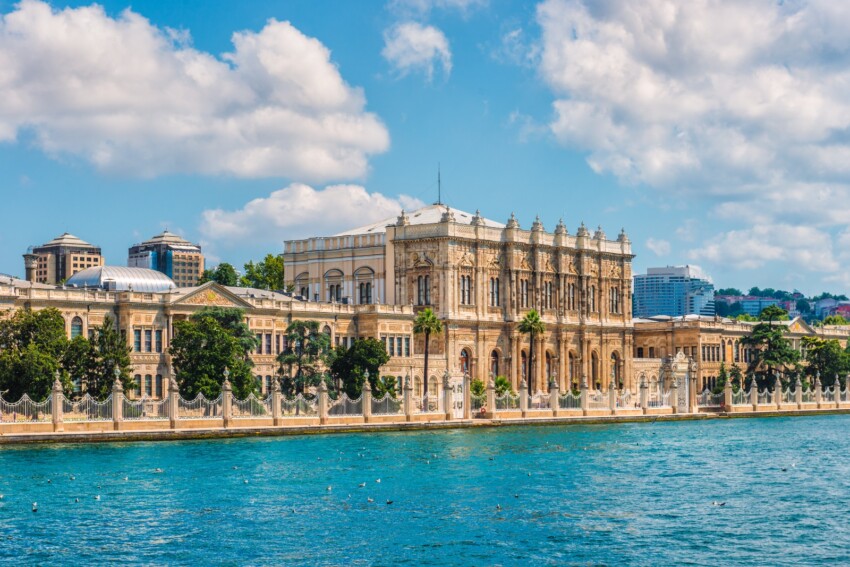
Built along the shores of the Bosphorus, Dolmabahçe Palace was the residence that from 1856 to 1922 housed the sultans who had decided to leave Topkapi Palace, considered too antiquated and lacking the luxury and comforts of modern buildings. In particular, it was Sultan Abdul Mejid I who, in 1843, wanted the construction of a residence overlooking the Bosphorus, on the European side of the city, which was to rival the great imperial palaces of Europe.
Construction work lasted more than thirteen years and resulted in a majestic and elegant complex that remains the largest palace in Turkey today. It was home to the last six Ottoman sultans as well as Mustafa Kemal Atatürk, founder and first president of the Turkish Republic.
Dolmabahçe Palace is a truly imposing complex, constructed by combining various Western architectural trends with Ottoman aesthetic. Its interiors are divided into three sections: a southern wing reserved exclusively for men, a northern wing that served as the private residential area, and a section for court life.
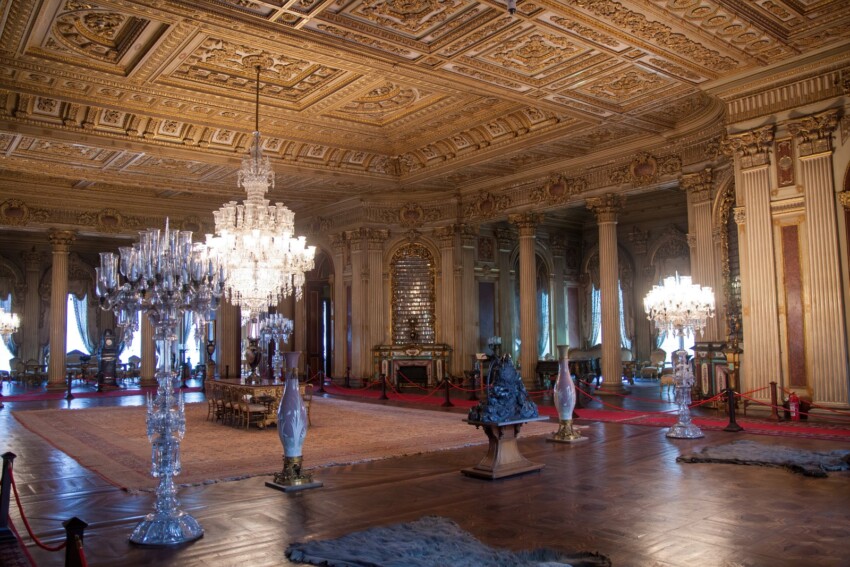
Considered the first palace in European style in Istanbul, this building extends across 45,000 square metres and houses furnishings and fittings that were state-of-the-art for its time. Within its walls are 285 rooms, 46 halls, 68 bathrooms and 6 hammams, all spaces furnished with sumptuous décor in marble and wood, crystal chandeliers and fine carpets.
As mentioned, Dolmabahçe Palace contains extraordinarily decorated and lavish halls that were intended to symbolise the wealth of the nineteenth-century Ottoman Empire. The Medhal Hall was designed to be the main entrance to Dolmabahçe Palace, where visiting guests were seated and made to wait before being received by the Sultan.
Upon entering the hall, visitors were immediately impressed by its sense of majesty, grandeur and opulence. The space features a grand marble staircase, whilst along the walls one can admire striking frescoes and sculptures. Looking upwards, visitors are easily captivated by the large crystal chandelier hanging from the ceiling.
Separating the public reception rooms from the harem (the family’s private quarters) is the Muayede Ceremonial Hall, a 2,000 m² hall topped by a dome that soars 36 metres high. The hall was primarily used for official visits and the most important imperial ceremonies, most notably the coronation of Sultan Abdul Hamid II in 1876. Inside, visitors can admire splendid Baroque-style decorations, glittering frescoes and elegant gold-leaf embellishments.
The residential quarters of the royal family, better known as the Harem, offer insight into the private life of the sultan’s household at Dolmabahçe Palace. This was home to the sultan’s mother, all his wives, concubines and young children. The harem contains eight interconnected apartments dedicated to the royal consorts, each with its own bathroom and furnishings of considerable value and elegance. In addition to these rooms, this section of the complex also includes several reception halls and some elegantly appointed reception rooms.
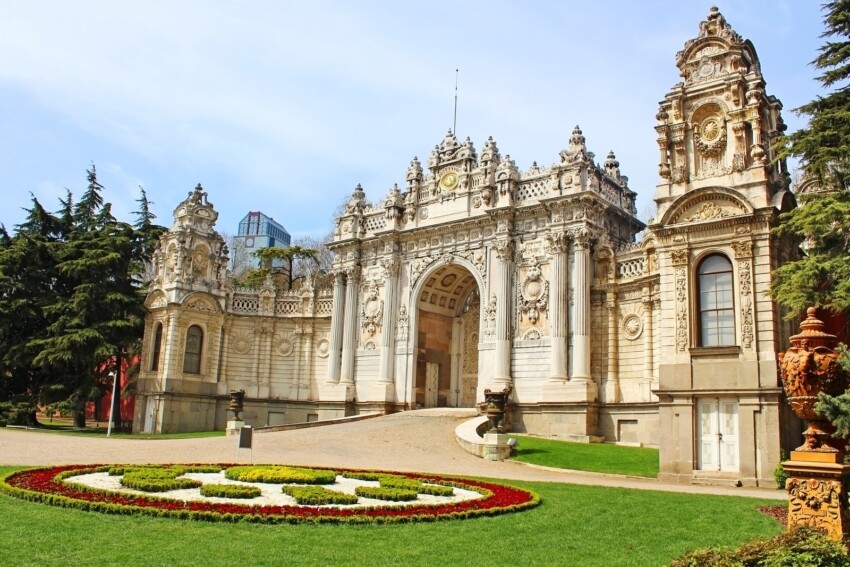
Originally, this area was a bay overlooking the Bosphorus used as an anchorage by the Ottoman fleet. However, given the magnificent views it offered, from the eighteenth century onwards increasingly more people began to appreciate the location, and many noble and wealthy merchant families chose to build lavish villas facing the strait. The area also became popular with the sultans themselves, and part of it was transformed into an imperial garden beloved by Ottoman rulers. The name “Dolmabahçe” derives from the creation of this royal garden, meaning “Garden Filled” – a term formed from the Turkish words “dolma” (filled) and “bahçe” (garden). Over time, between the eighteenth and nineteenth centuries, green spaces, summer palaces and pavilions were constructed here, forming what became known as the Beşiktaş Waterfront Palace.
Around 1843, Sultan Abdülmecid I decided to build a grand palace in Istanbul to rival those being erected across Europe, as Topkapi Palace had become too outdated and lacked modern amenities. He therefore ordered the demolition of Beşiktaş Palace and the construction of a new large residential complex in its place. The construction project was entrusted to two renowned architects of the period, Garabet Amira Balyan and Nigoğos Balyan, who were father and son. Work took place between 1843 and 1856, resulting in a building that combines elements of Baroque, Rococo and Neoclassical styles with traditional Ottoman architecture.
In 1861, the first international treaty between the Ottoman Empire and European states was signed at Dolmabahçe Palace – the Treaty of Paris. The complex housed six sultans from 1856 until 1922, when, during the reign of Caliph Abdülmecid Efendi, the Ottoman Empire was dissolved and the Palace seized by the newly established Turkish Republic. Mustafa Kemal Atatürk, founder and first president of the Turkish Republic, subsequently decided to use this palace as a summer residence and also as a place in which to spend the final years of his life. It was here that Atatürk died on 10 November 1938, and his study, preserved exactly as it was at the time, forms part of the palace tour. Since 1984, the Turkish government has converted the Palace into a museum open to the public, where visitors can discover the history of the Ottoman Empire and the Turkish Republic.
Dolmabahçe Palace is open daily, except Mondays, from 9:00 am to 6:00 pm. The last admission is at 5:30 pm.
Closed: all Mondays, New Year’s Day and the first day of Ramadan.
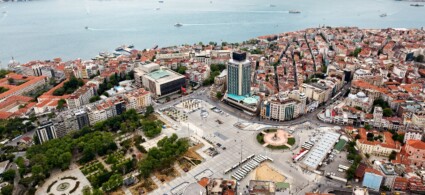
Dolmabahçe Palace is located in the Beşiktaş district and is easily accessible by public transport from both Sultanahmet and Taksim Square. From Sultanahmet, you can take the tram heading towards Kabataş and get off at the last stop; from there, the palace is a 5-6 minute walk away. From Taksim Square, you can take the F1 funicular down to Kabataş and then walk a couple of minutes to the Palace.
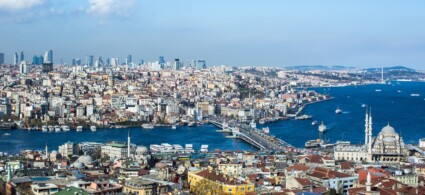
Dolmabahçe Palace stands in the Besiktas district (on the European side of Istanbul) near Kabatas ferry terminal and overlooks the Bosphorus Strait.
City Card allow you to save on public transport and / or on the entrances to the main tourist attractions.

 Hotel
Hotel  Budget accommodations
  Apartments
  Family Hotel
  Luxury Hotel