Bestseller
Istanbul: Blue Mosque & Hagia Sophia Guided Tour w/ Tickets
From 29,70 €
Buy the ticket
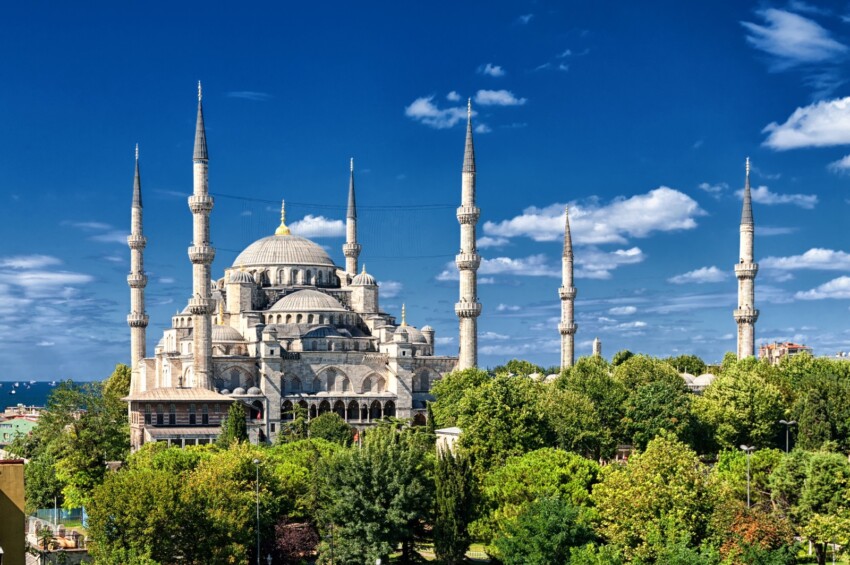
The Blue Mosque is also known as the Sultan Ahmed Mosque (in Turkish Sultanahmet Camii) and is considered a true architectural masterpiece. Built during the reign of Ahmed I, the mosque was only inaugurated in 1617 when Mustafa I was in power. The religious building is also called the Blue Mosque because its interior features splendid mosaics composed of more than 21,000 ceramic tiles in various shades of blue.
Unlike other sultans who had drawn on their personal wealth to construct mosques in the city, Sultan Ahmed used public funds to build what was intended, according to his plans, to be the most important place of worship in the Empire. Information about the design and construction of this magnificent mosque has reached us thanks to accounts recorded in several volumes held in the library of the Topkapi Palace.
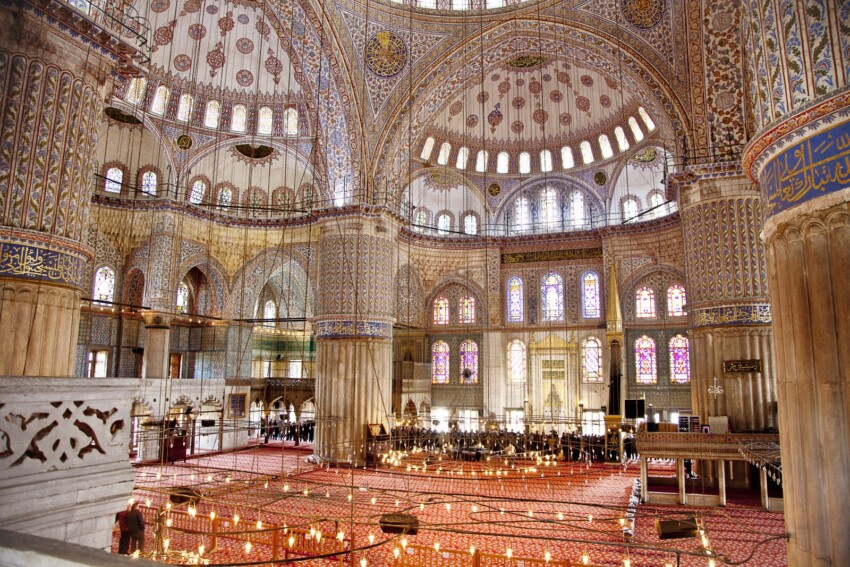
The Blue Mosque is another of Istanbul‘s sites that leaves visitors absolutely speechless with its beauty and history, which is why it’s always best to visit it with a guide. The religious building has a rectangular floor plan with a central vault, and entering from the main entrance, you reach a courtyard with a fountain from where you can admire the entire complex in all its splendour.
Moving inside, you’ll be immediately struck by its walls, which have been covered with over 21,000 Iznik tiles (ancient Nicaea) featuring shades of blue and azure. An genuinely surreal atmosphere is created by the light coming from 260 stained-glass windows and about a dozen hanging chandeliers that form truly evocative circles of light.
At the far end of the main hall stands the mihrab, the niche facing Mecca where a small fragment of the Black Stone of the Kaaba is kept (the original being in the centre of the Mosque of Mecca). The fragment has been placed within a marble niche considered a true sculptural masterpiece, with Quranic inscriptions.
Nearby is also the pulpit (or minbar) crafted in fine white marble and used by the Imam to conduct religious services. The Blue Mosque site is actually a complex that also houses other institutions such as a madrasa (a Quranic school), dining halls and shelters for the poor, and other support services.
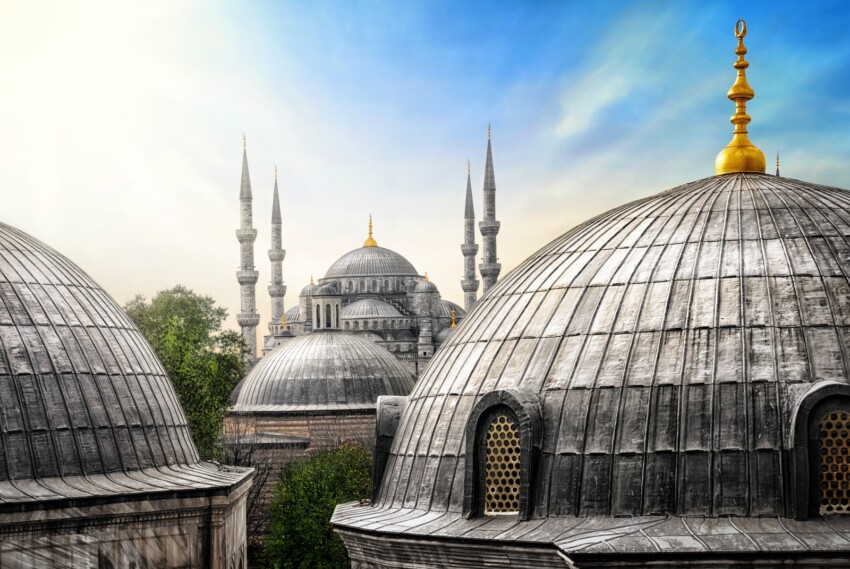
Towards the end of the 16th century, the Ottoman Empire found itself in dire straits following several wars fought against the Habsburg Empire and the Persian Empire, and at that time Sultan Ahmed I’s popularity was at an all-time low. For this reason, the sultan decided to reassert his power and that of the Ottoman Empire by constructing a new majestic place of worship. The Sultan Ahmed Mosque was the first to be erected in the capital since the Mosque of Süleyman, which had been built forty years earlier.
Despite achieving no military victories, the sultan decided to use public funds to build this mosque, which was to be the most important in the realm. This caused discontent among many, but in 1609 construction of the complex began on the site formerly occupied by the Grand Palace of Constantinople.
An important aspect related to the history of the Blue Mosque’s construction is certainly the number of minarets. Initially, it appears that due to a misunderstanding, the mosque was built with six minarets, the same number as those at the Kaaba Mosque in Mecca. This was considered offensive by many, so a seventh minaret was added to the Mosque of Mecca.
Construction of the Blue Mosque was completed with its inauguration in 1617 when Ahmed Mustafa I was sultan. Thanks to its harmonious architectural forms and its tall minarets, the Mosque is undoubtedly one of the city’s most iconic monuments, so much so that its image was also featured on Turkish 500-lira banknotes.
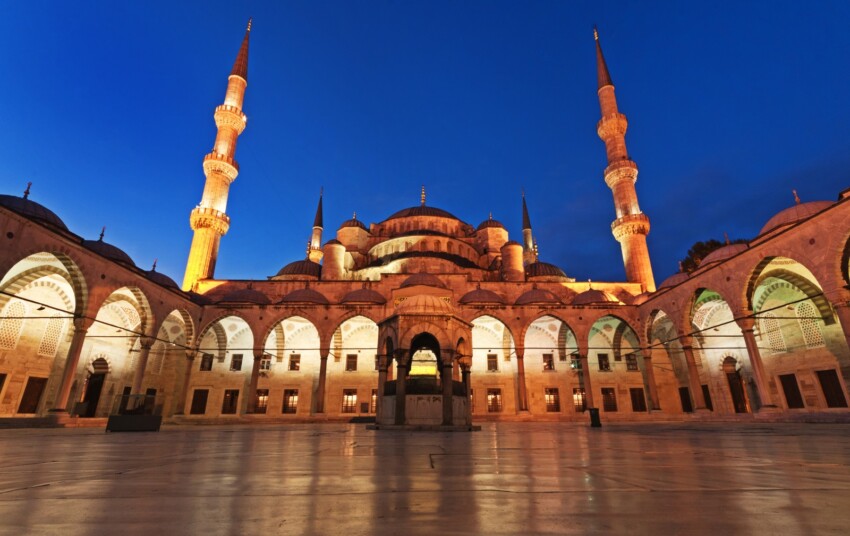
The Blue Mosque is open every day from 08:30 in the morning to 18:30 in the evening. During prayer times, however, the mosque is closed to the public.
Since this is a place of worship, appropriate dress is required, such as trousers reaching at least the knee, and women must have their shoulders and head covered, avoiding low necklines or revealing clothing. Before entering, it is also mandatory to remove your shoes.
The Blue Mosque is located in the Sultanahmet area, which was considered the heart of the ancient Ottoman capital, and this area can now be easily reached on foot, by public transport or by taxi. Those travelling from the Galata district can use the T1 tram line, which goes to the Sultanahmet stop (on Divan Yolu) located just a few steps from the Mosque.
From Taksim Square, you first need to take the F1 funicular to Kabatas and then the T1 tram to Sultanahmet stop. During the tram journey, you pass important points in the city such as the Galata Bridge and the Spice Bazaar before reaching the Sultanahmet tram stop. Taxis can also take passengers right up to Sultanahmet Square, which is a fully pedestrianised area.
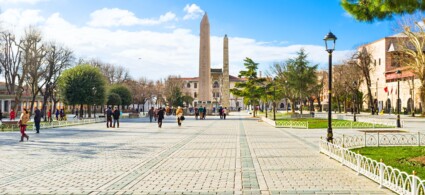
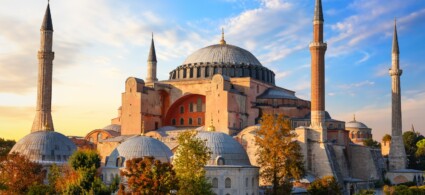
The Blue Mosque stands in Sultanahmet Square, a central area of Istanbul where you'll also find other sites of significant interest, including Hagia Sophia, the Hippodrome and Topkapi Palace.
City Card allow you to save on public transport and / or on the entrances to the main tourist attractions.

 Hotel
Hotel  Budget accommodations
  Apartments
  Family Hotel
  Luxury Hotel