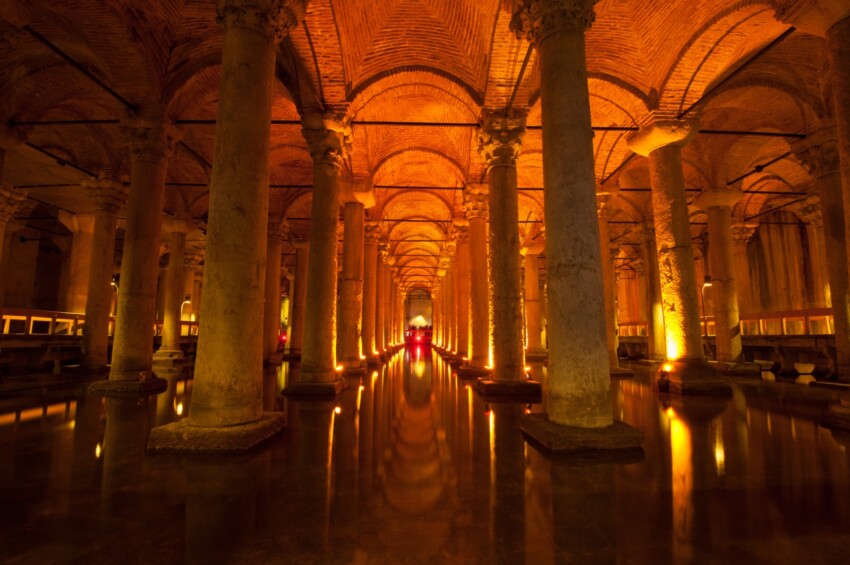
Bestseller
Istanbul: Basilica Cistern Fast-Track Entry and Audio Guide
From 37,00 €
Buy the ticket
The Basilica Cistern, also known as the Cisterna Basilica (or in Turkish Yerebatan Sarayı, literally “sunken palace”), is an underground space built in the 6th century AD to supply water to the palaces of the then-city of Constantinople. The cistern was also used during the early years of Ottoman rule but was later abandoned until a Dutch scholar rediscovered it in the 16th century.
The site has been restored several times and converted into a museum with an interesting visitor route that allows you to admire a true masterpiece of Roman engineering. Currently, the Basilica Cistern is one of the city’s most fascinating historical and architectural sites and an absolute must-visit during a trip to Istanbul.
The Basilica Cistern was an enormous underground area measuring approximately 140 metres by 70 metres that served as a water storage system capable of holding up to 80,000 cubic metres of water. Built around 532 AD with bricks and concrete in an underground zone, you now need to descend a stone staircase of over 50 steps to reach this spectacular building. Once inside, you can still admire 336 columns, each standing about 9 metres high and arranged in twelve rows, all stylistically very different from one another. The cistern’s pillars appear to be a combination of different architectural tendencies: some are Doric in style, others Corinthian, while still others were recovered from other buildings.
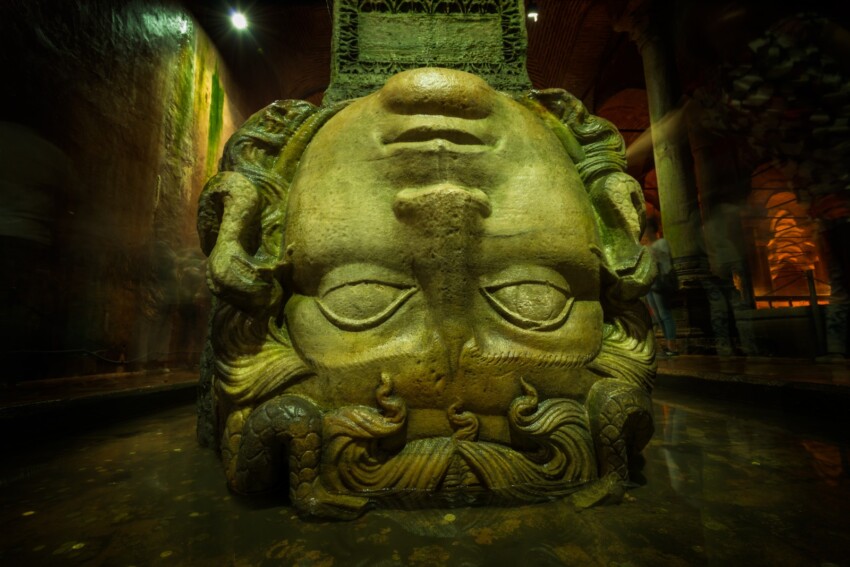
Two of the columns, moreover, have bases composed of a large Medusa head, one of the Gorgons who in Greek mythology had the power to petrify all those who met her gaze. The term Medusa in Greek means “protector” or “guardian”, so it is thought that these heads were positioned here to protect the water reserve. Some studies have also suggested that these were taken from ancient Roman buildings and added later.
In the nearly 40 years it took to build the Basilica Cistern, it appears that 7,000 slaves worked here, hundreds of whom unfortunately died during construction. To commemorate these men who perished, the “Weeping Column” was erected – an elegant column believed to have come from the Arch of Theodosius from the 4th century, featuring carved peacocks, flowers, reliefs and other decorative motifs.
The Cistern was designed as a reservoir to store water for supplying the Great Palace and other buildings in central Constantinople. The cistern was fed by the Valens Aqueduct, which was the city’s main water supply system and had been built during the 4th century AD as a series of aqueducts and channels extending throughout Thrace. Following the latest restoration (completed in 2022), the Basilica Cistern has been opened to the public with a route featuring several elevated walkways over the water that wind between the ancient columns. The atmosphere, enhanced by soft lighting, is truly captivating and offers visitors a perspective on the city’s ancient past.
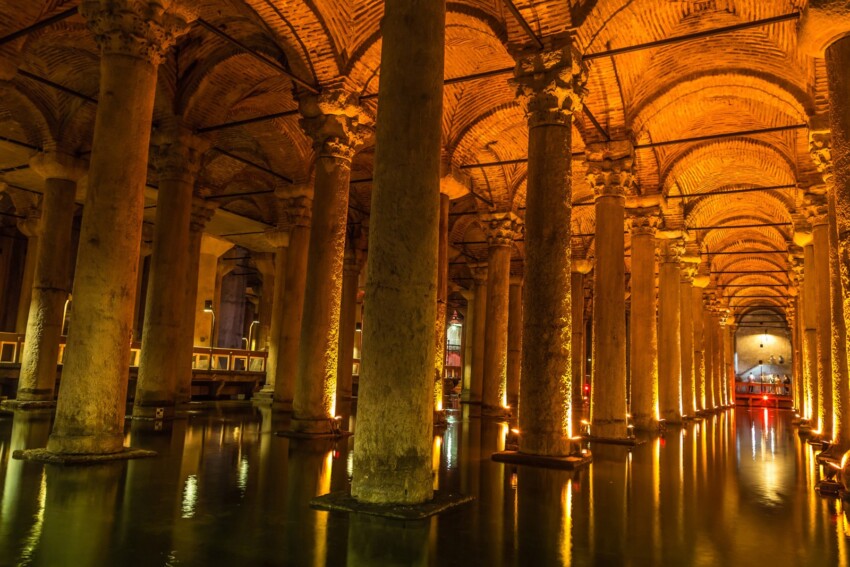
The Basilica Cistern was built in 532 AD by Emperor Justinian I on the site where a water storage structure had previously been erected by Emperor Constantine. This underground cistern’s function was to store water from the Valens Aqueduct to supply the city’s most important palaces.
During the Ottoman period, the cistern was used briefly to supply water to Topkapi Palace and the Harem but was then abandoned and neglected for centuries. It was rediscovered by chance in the mid-16th century by scholar Petrus Gyllius whilst conducting research and studies on ancient Byzantium. Once brought to light, the Cistern was restored for the first time during the sultanate of Ahmed III (1723) and then several times more through other maintenance work that made its current opening to the public as a museum possible.
Entry to the Basilica Cistern is paid, and given the long queues at the entrance, we recommend purchasing your ticket in advance. You can buy a skip-the-line ticket, combined with a guided tour, or take advantage of entry included with a city pass.
If you’re thinking of visiting other city attractions, such as the Blue Mosque and Hagia Sophia, or taking part in an unmissable Bosphorus cruise, consider purchasing a city pass.
The Basilica Cistern is open every day of the week from 9:00 to 22:00.
The Basilica Cistern stands in the Sultanahmet district, not far from Hagia Sophia. To reach the Cistern by public transport, you can take the T1 tram line to Sultanahmet stop and then walk approximately 250 metres towards the Basilica of Hagia Sophia – the Cistern is located on a side street nearby.
If you’re at Taksim Square, instead take the F1 funicular to Kabatas and then the T1 tram to Sultanahmet stop, from where it’s just a short walk.
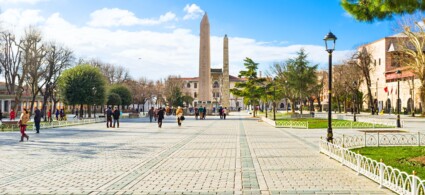
The Basilica Cistern stands in one of Istanbul's oldest quarters, where you'll find other monuments of considerable interest, vibrant bazaars and restaurants serving traditional Turkish cuisine. Just a short walk from the Cistern, you can discover attractions including Hagia Sophia, the Blue Mosque, the Hippodrome and Topkapi Palace.
City Card allow you to save on public transport and / or on the entrances to the main tourist attractions.



 Hotel
Hotel  Budget accommodations
  Apartments
  Family Hotel
  Luxury Hotel