A crossroads of peoples and cultures, Istanbul boasts a rich historical and architectural heritage. Here, then, are the sites you absolutely must visit in the city!
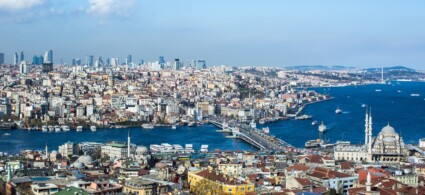
The magic of East meeting West can be experienced in Istanbul, cultural and economic heart of Turkey with over 2,000 years of glorious history. This vibrant metropolis, a crossroads of diverse cultures, has much to offer the visitor. Istanbul is fascinating, engaging, unpredictable, and filled with narrow ancient streets that nod to its more modern side.
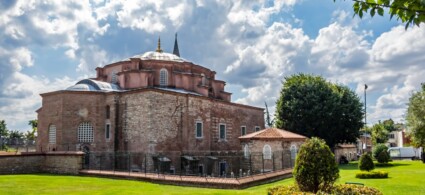
If you’re drawing up a list of what to see in Istanbul, you cannot overlook the Hippodrome, or Atmeydani, the Blue Mosque, called Sultanahmet Camii, Hagia Sophia, the Little Hagia Sophia, and naturally the Grand Bazaar and the Spice Market. Topkapi Palace and the Basilica Cistern, Yerebatan Sarniçi, are other essential points in the city to visit, perhaps before boarding a romantic ferry for a Bosphorus cruise. The Mosque of Süleyman and the Church of Chora, rich with stunning Byzantine mosaics, are also well worth seeing.
In Istanbul there is truly so much to see, and for lovers of modern art, the Istanbul Modern Art Museum and the galleries of Karaköy are absolutely not to be missed. If you fancy a day trip, consider Bursa, a veritable open-air museum that tells the story of this former first Ottoman capital, and Nicaea, also called Iznik. A Turkish bath can be the perfect and rejuvenating way to end a wonderful holiday day.
Sultan Ahmet, Ayasofya Meydanı No:1, 34122 Fatih/İstanbul, Türkiye
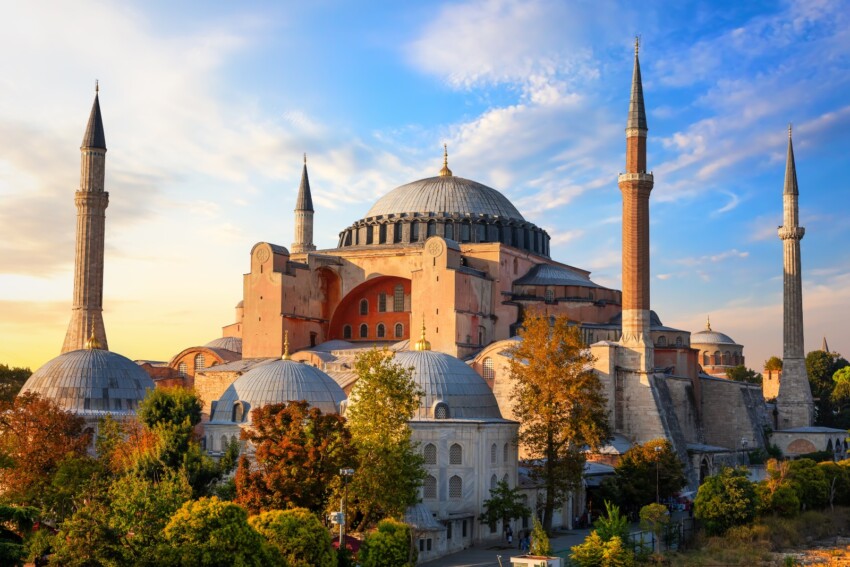
Considered one of Istanbul’s most iconic symbols and an essential stop during a visit to the city, Hagia Sophia is a true masterpiece of Byzantine architecture. Its construction dates back to 537 AD, when Emperor Justinian ordered the building of a magnificent Basilica on the remains of a previous church that had been destroyed twice before. Justinian ordered the construction of a more splendid religious edifice than its predecessors, which for years became the city’s most impressive place of worship. Over the centuries, the Basilica suffered considerable damage from earthquakes, fires and devastation, and lost numerous relics and artefacts of great religious and historical importance.
In 1453, Mehmed the Conqueror took Constantinople, and from that moment the Basilica of Hagia Sophia was converted into the mosque of Aya Sofya, where it remained until 1935. Subsequently, Mustafa Kemal Atatürk, Turkey’s first president and founder of the Turkish Republic, transformed the religious building into a museum so that all could admire this masterpiece. In 2020, however, Turkish President Erdoğan changed Hagia Sophia’s status once again from museum to an Islamic place of worship, which can nevertheless be visited by non-Muslims.
The interiors of Hagia Sophia remain a treasure chest filled with decorations, including numerous golden mosaics composed of approximately 30 million tiles, fine marbles and stucco work. Over the centuries, the building has retained its basilica layout, which was likely inspired by Constantine’s basilica design with three naves and a single apse that appears polygonal on the exterior. The columns between the naves are fashioned from porphyry or green marble from Thessaly and are decorated with intricately sculpted capitals. Given its long history and beauty, Hagia Sophia is listed among UNESCO World Heritage Sites, alongside other archaeological and museum sites in Istanbul’s historic district.
Cankurtaran, Babı Hümayun Cad No: 1, 34122 Fatih/İstanbul, Türkiye
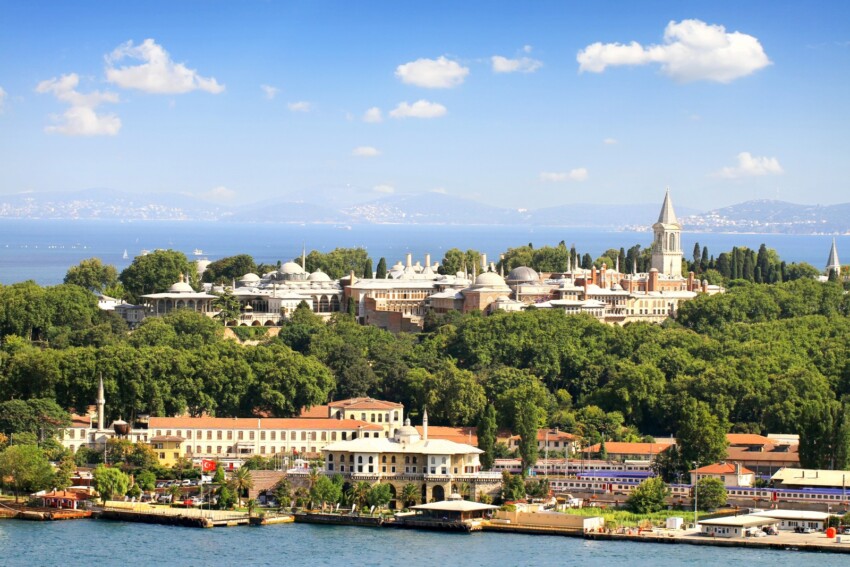
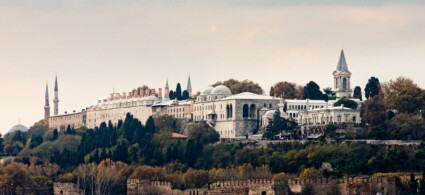
Not far from Hagia Sophia and the splendid Blue Mosque stands Topkapi Palace, which was built in the mid-15th century by Mehmed II on a promontory overlooking the Bosphorus. The complex, which now extends across nearly 700,000 square metres, was expanded and renovated several times over the centuries, as it was the centre of political life for many sultans of the Ottoman Empire until the mid-19th century. Within its walls are four courtyards that house numerous buildings of great interest, including pavilions, barracks, kitchens, dormitories and the harem.
Immediately in the first courtyard sits the Museum of Hagia Irene, a former Byzantine church better known as Aya İrini, which is considered the city’s first church. Moving on, you enter the second courtyard, which also houses the harem, the area dedicated to the imperial family and the women in the sultan’s service. Only the sultan was permitted entry to this zone, which is why the word “harem” literally meant “private” or “forbidden”. The third courtyard is perhaps the most important, as this was the sultan’s private area, guarded by white eunuchs. Here you’ll also find the Audience Hall, where officials and foreign ambassadors were received. Among the other rooms in this courtyard, you must not miss a visit to the Treasury, which houses precious objects and relics such as the 86-carat Kasikçi Diamond, the Topkapi Dagger, the Sword of Süleyman the Magnificent, and a throne covered in gold leaf and gems.
The fourth courtyard, by contrast, is full of elegantly decorated pavilions covered with coloured tiles in shades of blue, turquoise and white. Not to be missed is the Baghdad Pavilion, which has an octagonal form and is surrounded by 22 magnificent columns; this was erected to commemorate the capture of Baghdad in 1638. Due to its significance, Topkapi Palace is part of the “historic areas of Istanbul” and is thus listed among UNESCO’s World Heritage Sites.
Cankurtaran, At Meydanı Cd No:7, 34122 Fatih/İstanbul, Türkiye
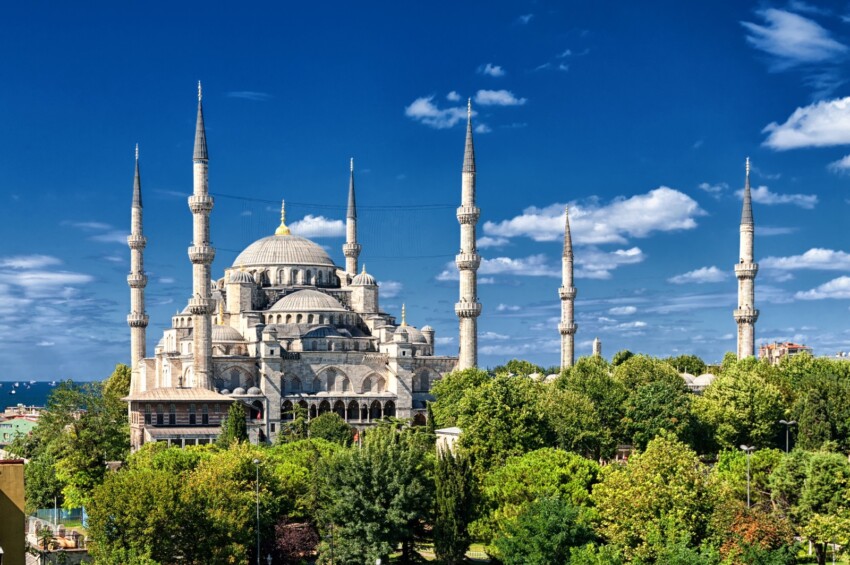
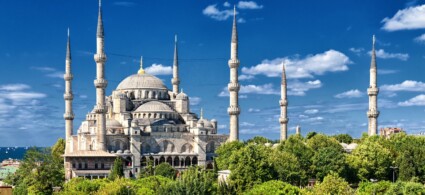
Facing Hagia Sophia stands the magnificent Blue Mosque, also known as Sultanahmet Camii, or the Mosque of Sultan Ahmed, who was also known as “the Fortunate”. Unlike his predecessors, Sultan Ahmed funded the construction of what was intended to be the Empire’s most important place of worship using public money. The planning and construction of this site is described in eight volumes housed in Topkapi Palace’s library.
The Blue Mosque derives its name from the magnificent mosaics inside, composed of more than 21,000 tiles of blue ceramic. The walls and columns are clad in tiles from Iznik (ancient Nicaea) in shades of blue, turquoise and green, which, combined with light from the 260 windows, create stunning interplays of light and an almost surreal atmosphere.
Another important feature of the Blue Mosque is the number of minarets. Initially, the mosque was built with six minarets (apparently due to an error), the same number as those at the mosque of the Kaʿba in Mecca. Many found this to be an affront, so the mosque in Mecca added a seventh minaret.
Binbirdirek, Sultan Ahmet Parkı, 34122 Fatih/İstanbul, Türkiye
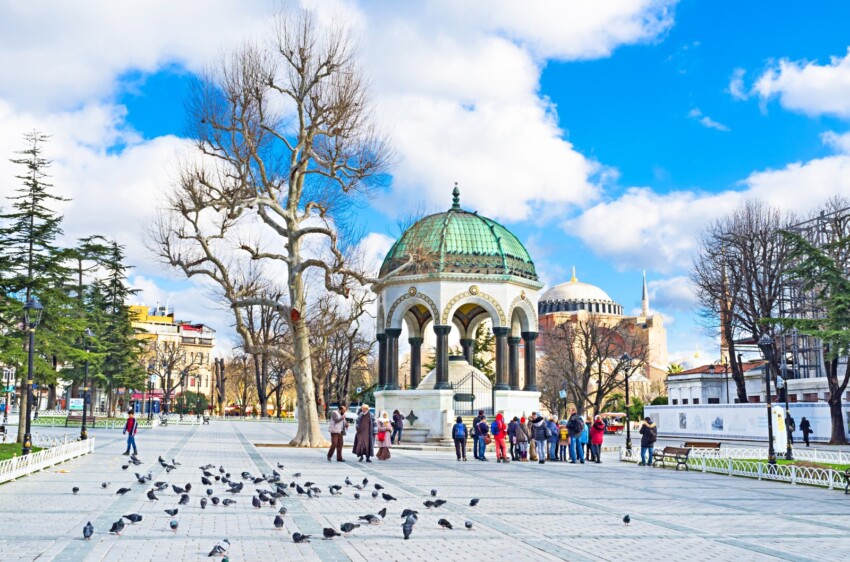
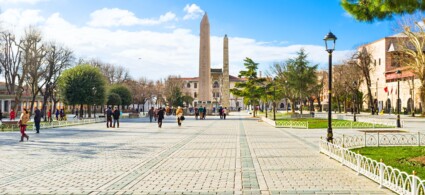
Initially built around the 3rd century AD by Emperor Septimius Severus, the Hippodrome of Istanbul was later enlarged by Constantine I, who wished to make the then-Constantinople a “New Rome”. Known in Turkish as Atmeydani, or the Hippodrome Square, this venue boasted impressive dimensions that made it second only to Rome’s Circus Maximus at the time. Nearly 400 metres long and 130 metres wide, it could accommodate approximately 100,000 people who gathered to watch chariot races and competitions. Initially built as an entertainment venue, the Hippodrome later became a place for government and public gatherings.
Over time, this new function made it a focal point for protests and uprisings, such as the famous Nika Riots, during which rebels sought to overthrow Emperor Justinian. During this rebellion, the city was set alight and devastated for nearly a week, and the Basilica of Hagia Sophia was partially damaged. Only the celebrated General Belisarius was able to quell these disturbances, condemning nearly 30,000 rebels to death, who were slaughtered at the Hippodrome itself.
Unfortunately, over time the site lost its original splendour and was not only robbed of some of its decorations (such as the horses’ statues, which were transferred to Venice and now stand in the Basilica of St Mark), but also used as a quarry for building materials for constructing new structures. You can still admire here: the Obelisk of Theodosius (commissioned by Pharaoh Thutmose III and brought to Constantinople by Theodosius I), the Serpent Column (from the Sanctuary of Apollo at Delphi and brought here by Constantine), and the Column of Constantine VII, once elaborately decorated.
Grand Bazaar
Beyazıt, 34126 Fatih/İstanbul, Türkiye
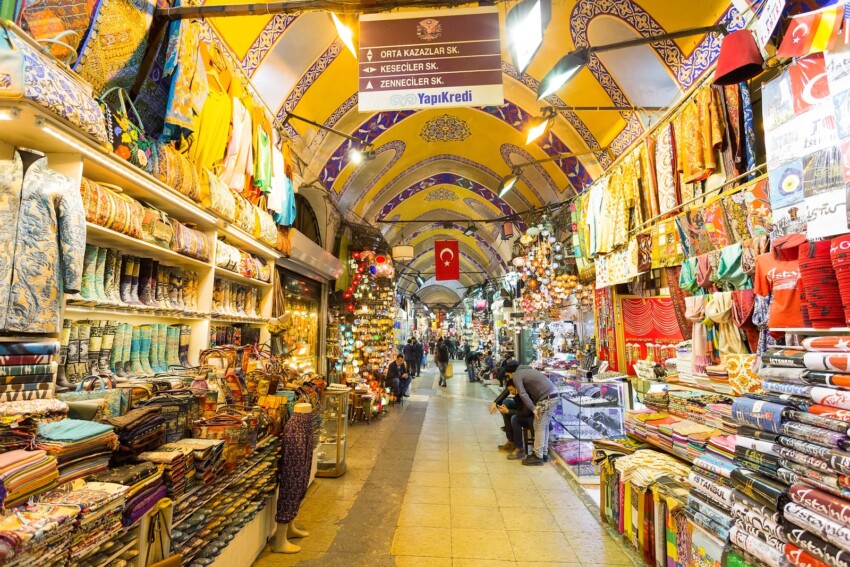
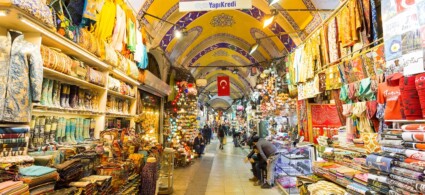
The Grand Bazaar (or Kapali Çarşı, meaning “covered market”) is one of the world’s oldest and largest covered marketplaces and is located in Istanbul’s old quarter, not far from the Hippodrome. Commissioned by Mehmed II around 1460, the complex has been expanded many times over the years and now houses nearly 4,000 shops selling goods and products of every kind. The Grand Bazaar is like a city within a city: within it are 60 streets, each dedicated to different products such as jewellery, carpets, clothing, shoes, brass items and much more.
Chaotic and heavily frequented, the Grand Bazaar is an absolute must-see during a visit to the city, as you can pick up souvenirs from your trip; the only rule to remember is to haggle! In addition to numerous shops, Istanbul’s Grand Bazaar also houses a few small cafés serving Turkish coffee and tea with local sweets, a mosque and a bank.
Basilica Cistern
Alemdar, Yerebatan Cd. 1/3, 34110 Fatih/İstanbul, Türkiye
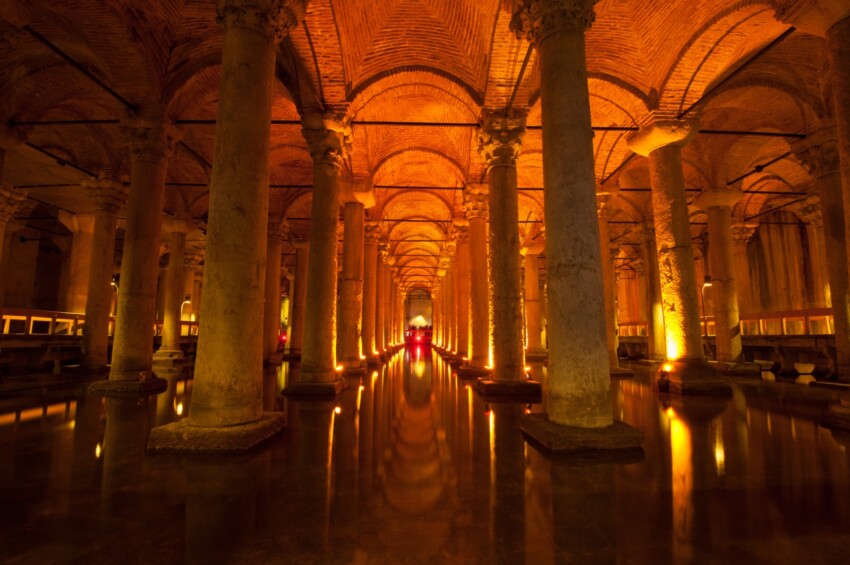
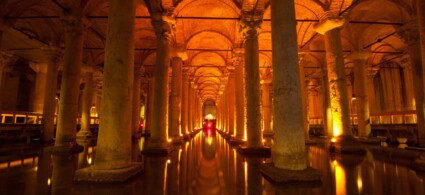
The Basilica Cistern is a vast underground chamber measuring approximately 140 metres by 70 metres, constructed in 532 by Emperor Justinian I on the remains of an earlier structure commissioned by Emperor Constantine. Within it stand 336 columns, arranged in twelve rows, erected in various styles: some are Doric in style whilst others are Corinthian. Moreover, many capitals were constructed using materials from other sites.
The cistern was fed by the Valens Aqueduct, one of the longest aqueducts of the Roman era, and the city’s principal water supply system. The Cistern remained in use until the Ottoman arrival and subsequently fell into disuse. Rediscovered towards the end of the 16th century by scholars, it was later restored several times (the most recent restoration work dates to 2022) and opened to the public as a museum.
Kemankeş Karamustafa Paşa, Galata Köprüsü, 34425 Beyoğlu/İstanbul, Türkiye
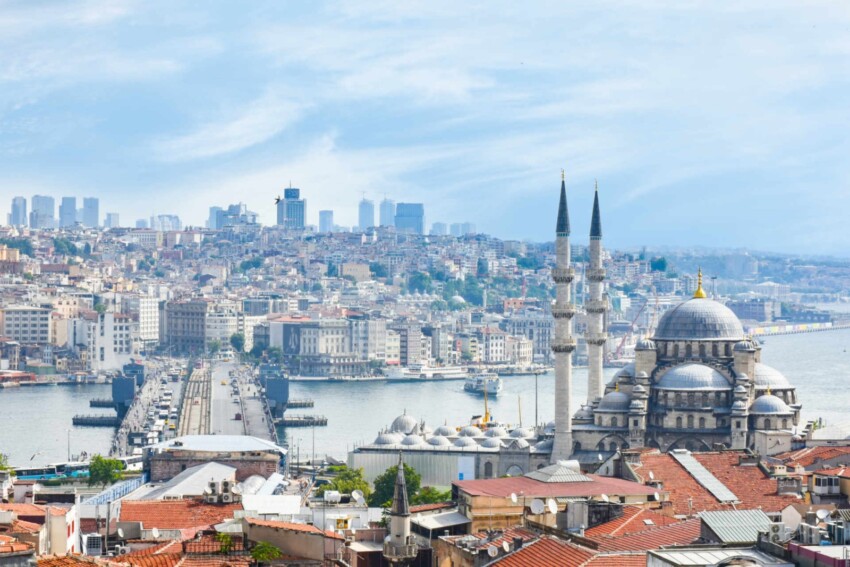
The Galata Bridge connected the old city of Istanbul, with its imperial palaces, mosques and Ottoman institutions, to the Galata district, the historic heart of Beyoğlu, a neighbourhood on the northern shore of the Golden Horn. Beyoğlu was once home to the embassies and European mansions of foreign diplomats and Western merchants. The Galata Bridge is open to tram, car and pedestrian traffic, and crossing it is a truly unique experience as it allows you to observe and feel the differences between the two neighbourhoods it joins.
One of the earliest construction projects for the Galata Bridge was commissioned to Leonardo da Vinci, who designed a single-span bridge 360 metres long and 24 metres wide, but the sultan rejected his plans. Michelangelo was also consulted, but his design too was dismissed. Eventually, the first Galata Bridge at this location was built in 1845, though it has since been destroyed and rebuilt several times. What we see today is a bascule bridge, 490 metres long, with three lanes in each direction (for vehicles and the tram line) plus two pavements on either side. In the 2000s, a pedestrian passage lined with numerous restaurants and bars was added below street level.
Galata District
Crossing the Galata Bridge, which spans the Golden Horn, takes you to the district of the same name, which was a Genoese colony for nearly two centuries, from 1273 to 1453. The Galata Tower is the defining symbol of this rule, built in 1348 by Rosso Doria, who was both the first Genoese governor of Galata and the first Christian governor in these lands.
Galata sits on a hillside that has boasted paved streets and stone buildings since ancient times, along with several churches. In the twentieth century, outdoor cafés, restaurants, art galleries, small shops, boutiques and artisan workshops were added to the mix. When the Turks conquered Constantinople, the Genoese quickly surrendered but secured the safety of their citizens and a degree of autonomy in this area. From then on, Galata became something of an enclave where embassies of Western powers, banks, commercial offices and additional churches were established.
Galata Tower
Bereketzade, 34421 Beyoğlu/İstanbul, Türkiye
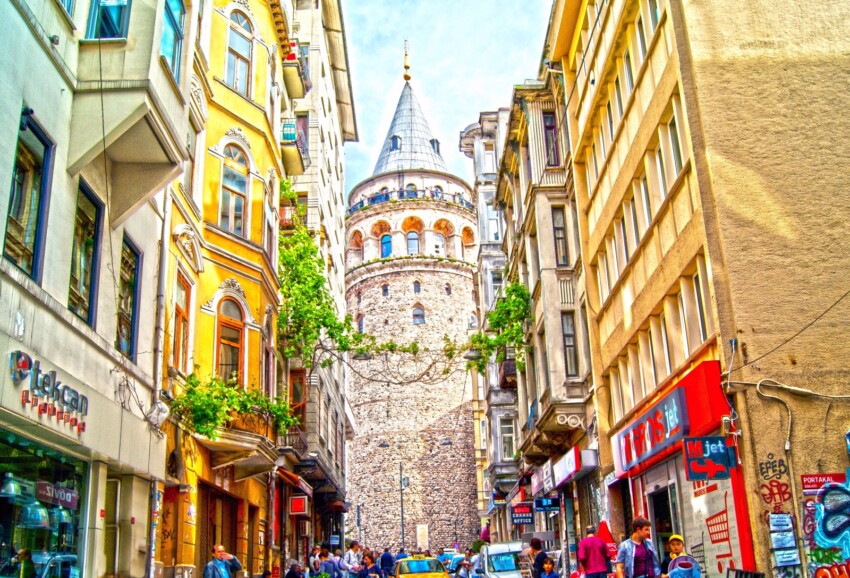
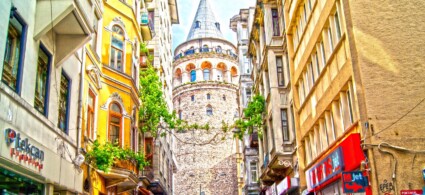
The Galata Tower (or Galata Kulesi) is a stone tower in the district of the same name, built by the Genoese around the mid-fourteenth century. Previously, a wooden tower had been constructed in this area, whose position allowed it to command the entire territory. With the arrival of the Genoese, Rosso Doria, the first Genoese governor of Galata, had a tower built here, called the Tower of Christ (Christea Turris), which formed part of the district’s defensive fortifications. This bastion stands at the highest point of the hill, 35 metres above sea level, and from its top you can see not only the Bosporus strait but also a vast expanse of the Sea of Marmara, which was strategically important for trade routes at the time.
The Galata Tower has suffered various earthquake and fire damage over the years, but has always managed to stand firm, though some sections have been rebuilt. As a result, you can see inside how Genoese architectural style is combined and blended with Ottoman influences. Over time, the building served as a prison, fire watchtower and as a venue for scientific and astronomical studies; from the highest floor of the tower, in the seventeenth century, an astronomy expert named Hezarfen Ahmet Celebi decided to launch himself with a pair of mechanical wings and managed to land on the other side of the Bosporus. According to some, this should be regarded as the world’s first intercontinental flight.
Externally, the tower is cylindrical in form, topped by a conical roof that’s visible from various points across the city. Inside, there are nine floors and two lifts that lead to the top, where you’ll find a panoramic terrace with a 360° view of Istanbul, particularly over the old city, the Bosporus and the Golden Horn. Recently, an elegant restaurant, the Galata Tower Restaurant, opened on the tower’s top floor, allowing you to dine whilst taking in the whole city from above.
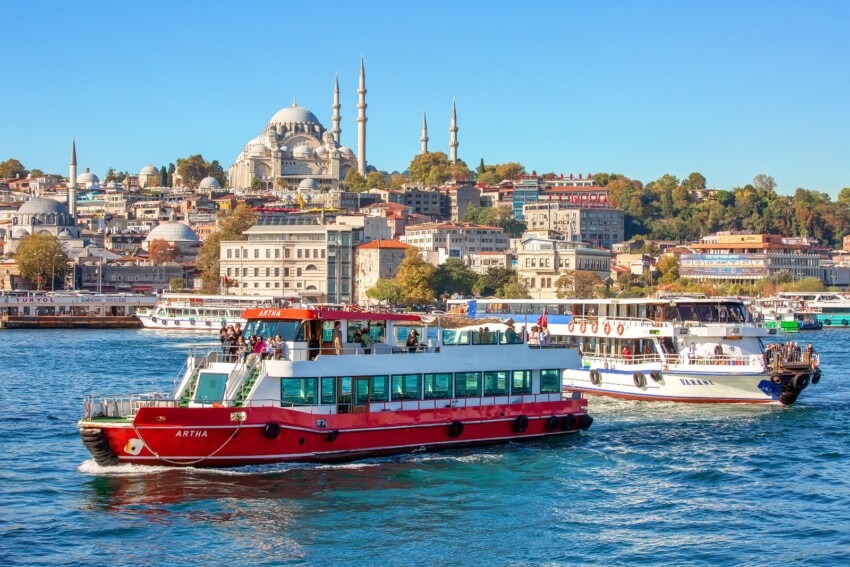
One of the best ways to appreciate Istanbul is certainly to take a Bosporus cruise, as from the boat you can admire both the European and Asian sides from a different perspective. The Bosporus is the strait that divides Istanbul into two parts (European and Asian), but at the same time connects the Black Sea with the Sea of Marmara. The Bosporus strait is approximately 30 km long, whilst its width varies from 700 metres at its narrowest points to nearly 4 km at the mouth of the Black Sea. There are numerous types of cruises and ferries available that allow you to navigate the waters of the strait and see the city from another angle, but we recommend tours lasting at least an hour and a half so you can properly enjoy the scenery and main points of interest.
One of the best times to take a sightseeing tour is certainly at sunset, a time particularly recommended in summer when the sky turns orange, providing spectacular views. Some companies offer hop-on–hop-off services, allowing you to disembark at intermediate stops, visit sites of interest and then board the next service. Others are full cruises that include dining on board, live music performances and the chance to see Istanbul illuminated at night.
Vişnezade, Dolmabahçe Cd., 34357 Beşiktaş/İstanbul, Türkiye
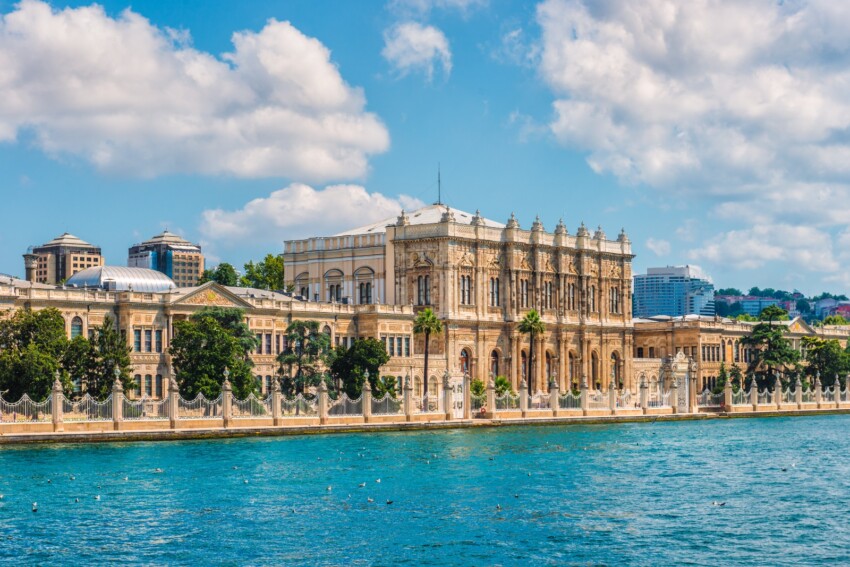
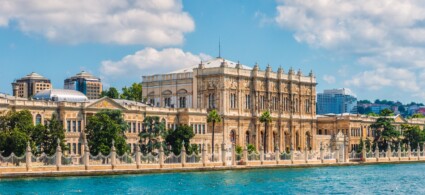
From 1856, the residence of the sultans was moved from Topkapi Palace to Dolmabahçe Palace, which became the seat of the caliphate until 1924. Considered the city’s first European-style palace, the building extends over 15,000 square metres, making it the largest in all of Turkey. Dolmabahçe Palace was constructed between 1843 and 1856 at the behest of Sultan Abdul Mejid I and overlooks the Bosporus on the European side of the city.
The complex is divided into three main areas: one reserved for men, one for women (the harem) and an area dedicated to court life. Built in emulation of the principal European palaces of the nineteenth century, the building combines different architectural styles, blending Baroque, Rococo and Neoclassical elements with various motifs from traditional Ottoman architecture. In particular, the state apartments contain more than 280 rooms, including a fine hammam made of marble and alabaster.
The palace preserves extraordinarily decorated and lavishly ornate rooms that were meant to symbolise the wealth of the Ottoman Empire. After the fall of the caliphate, Mustafa Kemal Atatürk, the first president of the Turkish Republic, spent his final years in this building and died here on 10 November 1938. Since 1984, Dolmabahçe Palace has been converted into a museum that tells the story of the Ottoman Empire and the Turkish Republic.
Taksim Square, Kocatepe, 34435 Beyoğlu/İstanbul, Türkiye
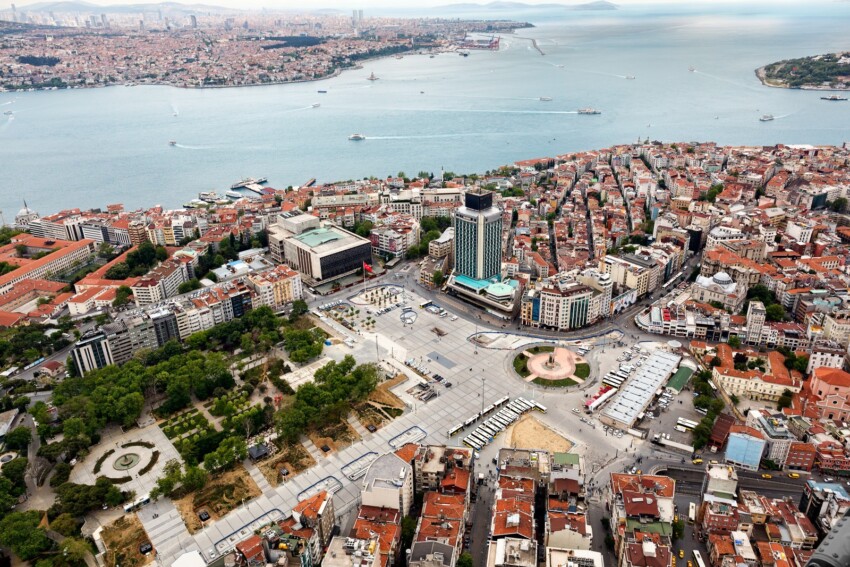
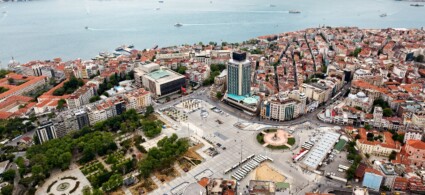
Taksim Square, known in Turkish as Taksim Meydani, is located in the European part of Istanbul and is a modern area full of shops, restaurants and major hotel chains. The Monument to the Republic, erected here in 1928 by Italian sculptor Pietro Canonica, celebrates the founding of the Turkish Republic in 1923. The square is frequently used for public events, celebrations and demonstrations, some of which have ended in violence with police intervention.
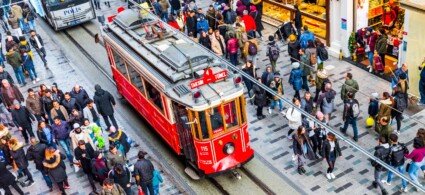
The name “Taksim” in Turkish means “distribution”, as water distribution to the city took place here from the eighteenth century onwards. This area remained the northern outskirts of Istanbul until the last century, becoming the heart of new Istanbul only with the city’s expansion. From the square now runs one of Istanbul’s most famous shopping streets, Independence Avenue (or Istiklal Caddesi), a pedestrian street lined with boutiques, cafés and restaurants and crossed by the line of an old tram.
Süleymaniye Mosque
Süleymaniye, Prof. Dr. Sıddık Sami Onar Cd. No:1, 34116 Fatih/İstanbul, Türkiye
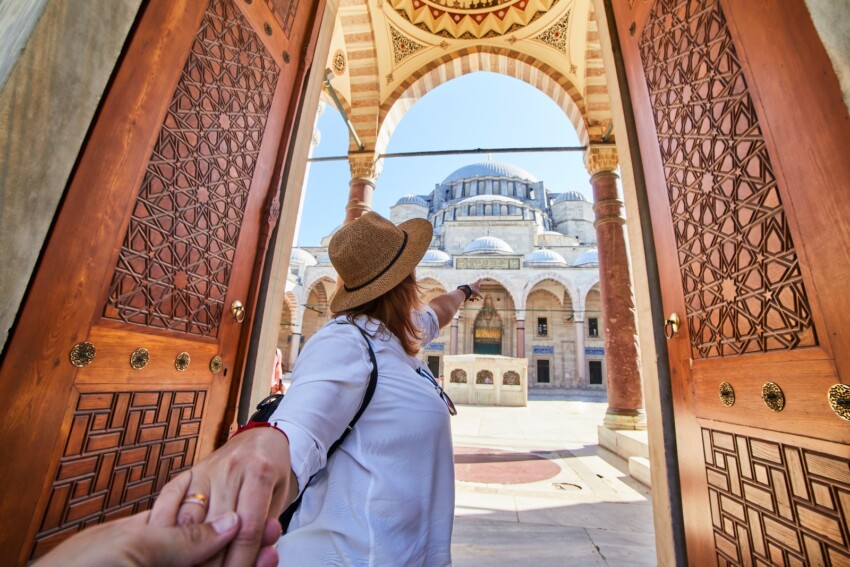
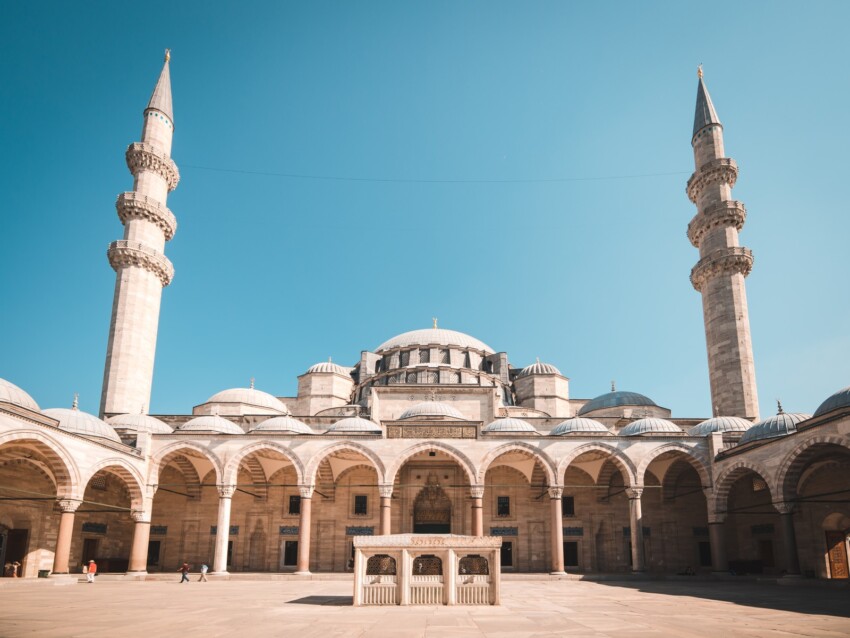
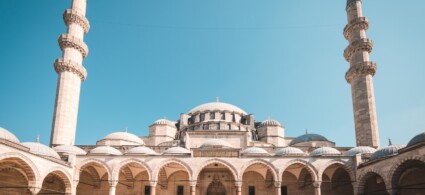
The Süleymaniye Mosque (Süleymaniye camii) was commissioned by one of the most renowned Ottoman sultans, Süleyman the Magnificent (1520–1566), who called upon the famous sixteenth-century imperial architect Mimar Sinan for the project. At the time, it was the fourth mosque in Istanbul, after those of Fatih, Bayezid and Selim (Selimiyye), and the site chosen for this religious building was the top of a hill that offers a splendid view over the city and the Golden Horn.
Set amid lush vegetation, the mosque can accommodate almost five thousand worshippers and was the largest in the city for nearly five hundred years, until it was surpassed by the Çamlica Grand Mosque in 2019. Its interior features remarkable acoustics that allow even the smallest sound to be heard in every corner of the mosque.
Externally, you’ll notice four tall minarets and, at the centre of the building, the great dome surrounded by smaller semi-domes. Around the mosque, various important buildings were constructed, including madrasahs (Qur’anic schools), a hospital, a library, a hammam and a restaurant. Some of these buildings remain as they once were, whilst others have been converted into cafés or restaurants.
Church of the Holy Saviour in Chora
Derviş Ali, Kariye Cami Sk. No:18, 34087 Fatih/İstanbul, Türkiye
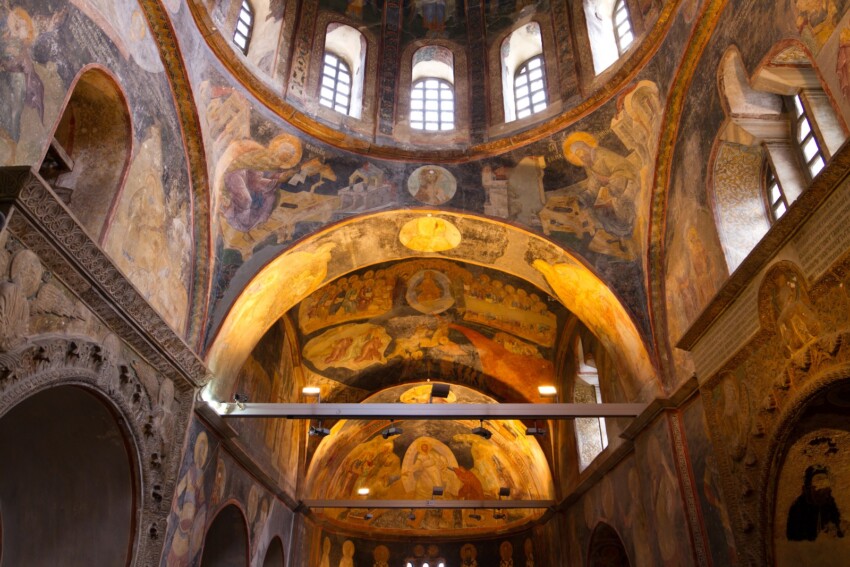
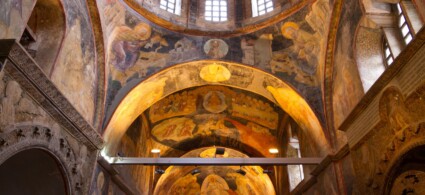
The Church of the Holy Saviour in Chora stands in the Edirnekapi district in the western part of Istanbul, and the term “Chora” means “outside the city” as the building was originally constructed outside the city walls. The church was first built in the sixth century but was destroyed and rebuilt between 1316 and 1321, and is now considered one of the most important examples of Byzantine sacred architecture.
Inside, it houses splendid Byzantine frescoes and mosaics dating from the fourteenth century that have survived to the present day in excellent condition, depicting themes such as the Incarnation, Salvation and the Resurrection. The artworks here have been well preserved mainly because, following the Ottoman conquest of Constantinople, the church was converted into a mosque and the frescoes and mosaics were plastered over out of respect for Islamic law.
The church was transformed into a mosque in 1511 by decision of Bayezid II, son of Ottoman sultan Mehmed II, and remained an Islamic place of worship until the mid-twentieth century, when it was converted into a museum (Kariye Müzesi). In 2020, however, President Erdoğan announced that the Church of the Holy Saviour in Chora, like Hagia Sophia, would once again become a mosque.
Egyptian Bazaar
Rüstem Paşa, 34116 Fatih/İstanbul, Türkiye
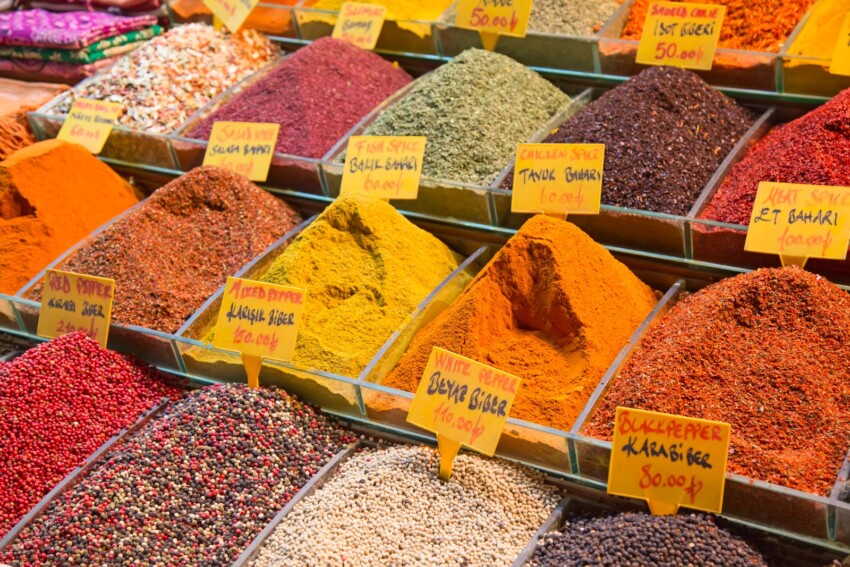
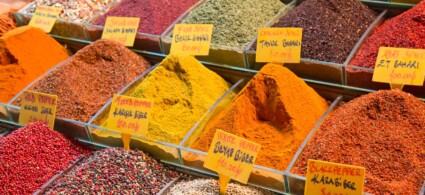
The Egyptian Bazaar stands just a short distance from the Galata Bridge and is another of Istanbul’s great covered markets, though considerably less famous and less crowded than the Grand Bazaar. Originally known as the “New Bazaar,” the “Egyptian” designation was added later because the market was built using revenue from taxes collected in Egypt, then an Ottoman province. The site was constructed around 1660, and the rent charged to merchants of that era was used to cover the running costs of the New Mosque (Yeni Cami), erected in the area at the behest of Safiye Sultan, wife of Sultan Murad III.
Initially, this market dealt primarily in spices, dried herbs, tea, nuts, dried fruits and pestil—a Turkish confection made from dried fruit—and was therefore also known as the “Spice Bazaar“. In more recent times, however, many traders have diversified, and nowadays many also sell clothing, accessories and jewellery. Beyond the opportunity to pick up local products or traditional food, the Egyptian Bazaar is a veritable paradise for fragrance enthusiasts and photographers alike. Surrounding the bazaar is a vibrant area bustling with market stalls and shops selling fresh fruit, vegetables and other produce.
Guided and free tours of Istanbul
Discover Istanbul through the eyes of expert guides who will take you on a tour of the city's hidden treasures. Participating in a guided visit or a free tour will allow you to capture the true essence of Istanbul.
The free tours are a viable alternative to traditional guided tours. They work like this: participation is free and at the end of the visit you can leave a tip at your discretion. Below you will find our favourite free tour, otherwise you can see the full list by visiting this page.

 Hotel
Hotel 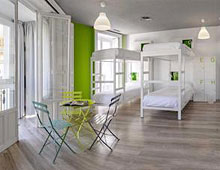 Budget accommodations
 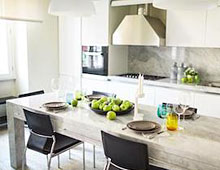 Apartments
  Family Hotel
 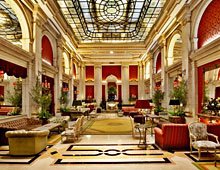 Luxury Hotel